There’s something pretty satisfying about taking a basket of fresh apples and turning them into something you can enjoy long after the harvest is over.
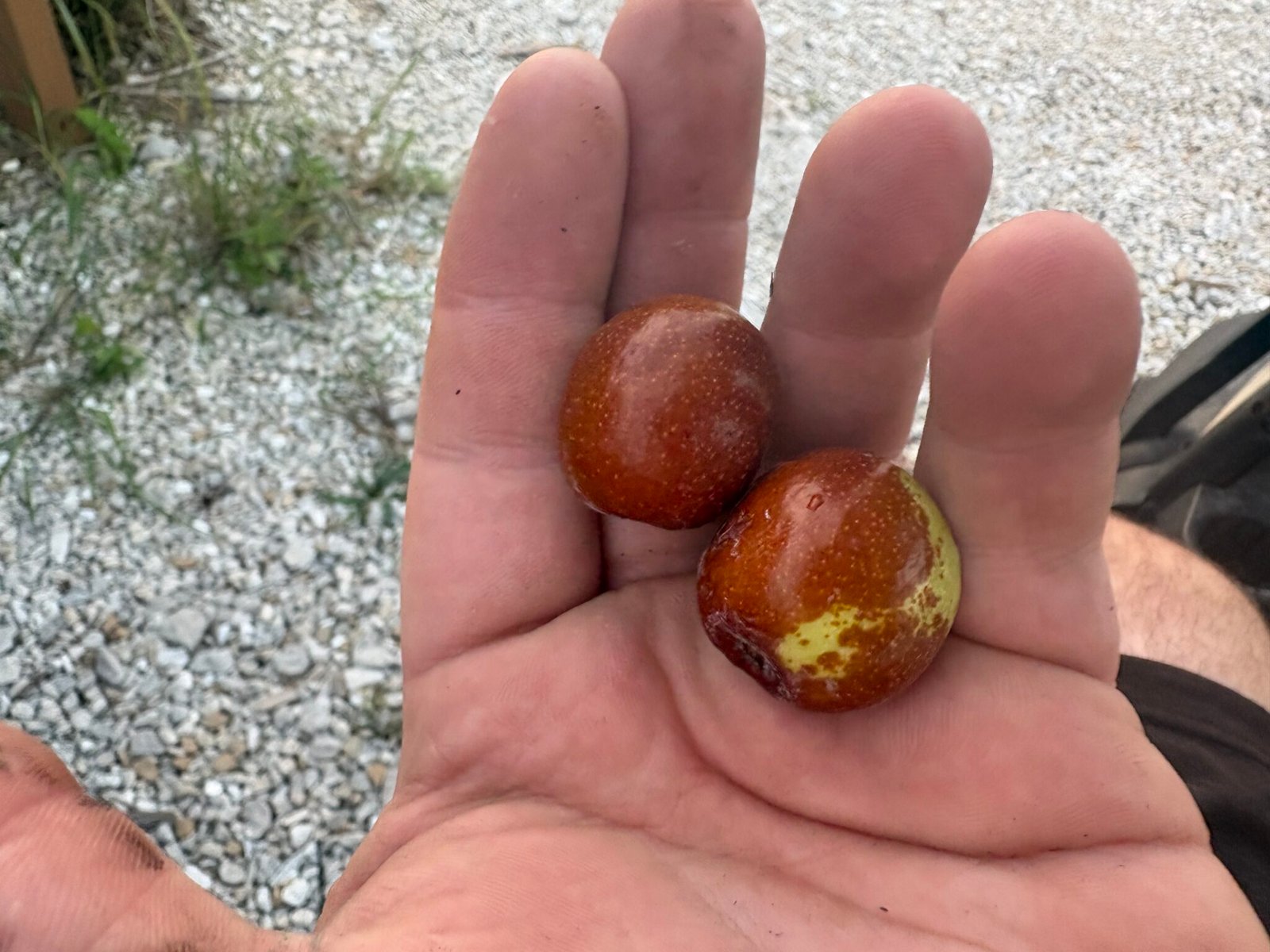
Apples are one of my favorite fruits to work with because there are so many different things you can make from them. Here on our Missouri family farm, we grow apple trees alongside peaches, pears, jujubes, pawpaws, and several other fruit crops. We’ve also spent quite a bit of time exploring different ways to use apples, especially in homemade apple butter, jams, and preserves.
But drying apples opens up another possibility.
Instead of cooking them down into a spread or storing them in the refrigerator, you can remove much of their moisture and turn them into chewy apple rings or thinner dried apple slices.
And you don’t necessarily need to add any sugar.
The natural sweetness of the apple becomes more concentrated as water is removed, which is one reason dried apples can taste so good.
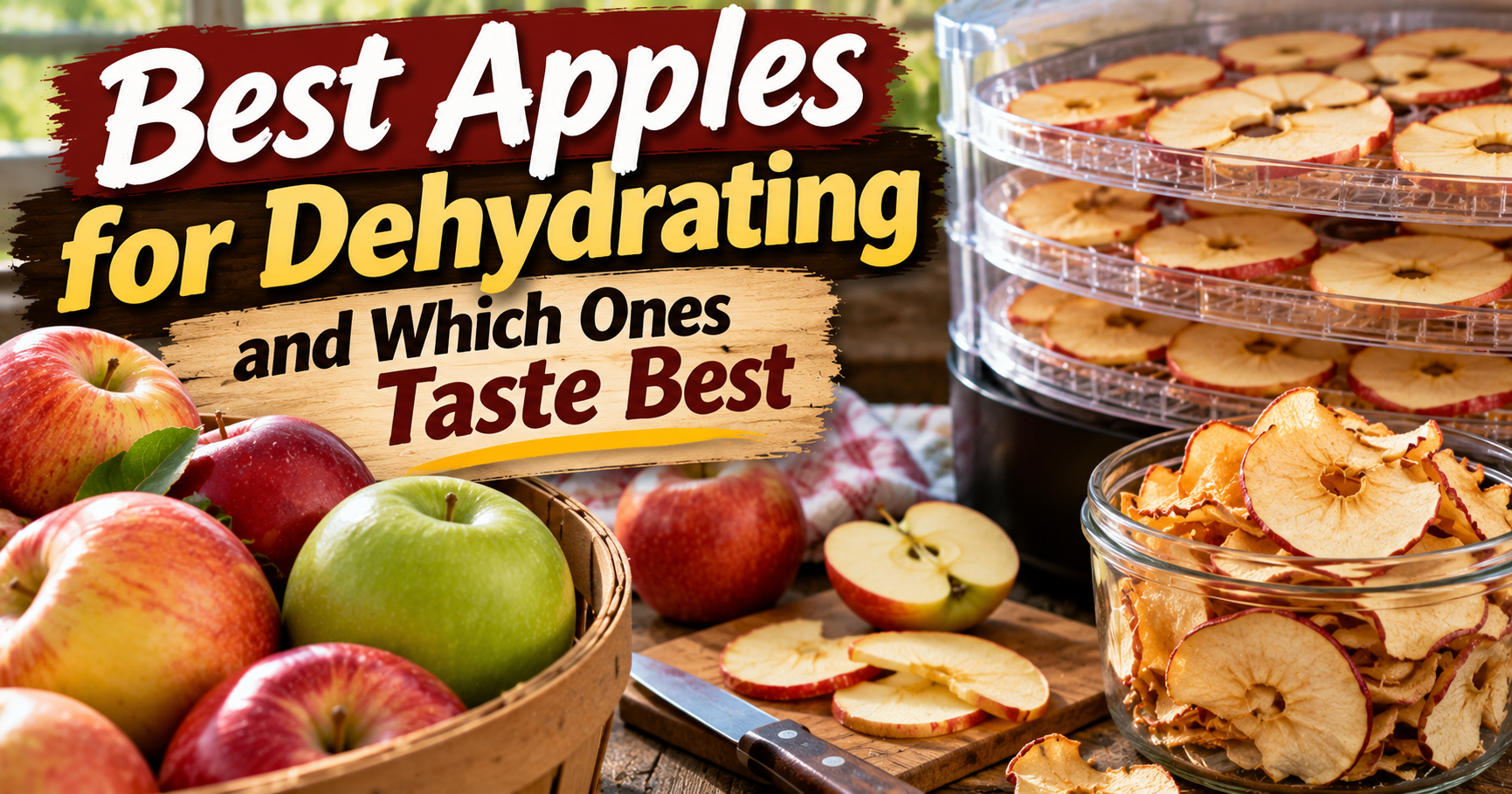
The best apples for dehydrating are Fuji, Gala, Honeycrisp, and Granny Smith. All four are recommended by Illinois Extension for drying, although they produce different flavors. Fuji and Gala are good choices when you want naturally sweet dried apples. Granny Smith is better when you prefer a tart bite, and Honeycrisp offers a pleasant balance of sweetness and acidity.
But those aren’t the only apples worth drying.
There are several other varieties I’d consider, especially if you’re growing your own apple trees and want to make the most of your harvest.
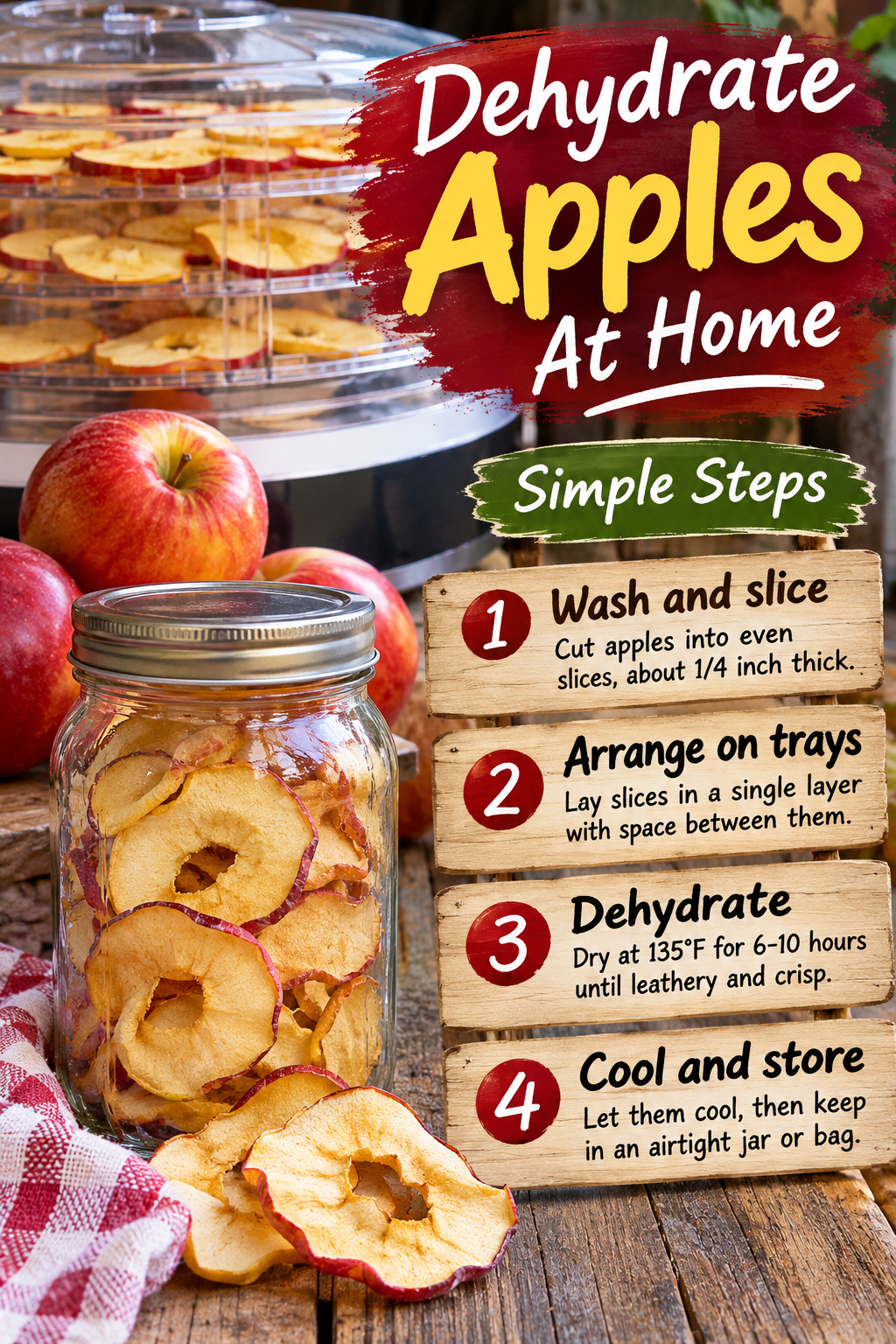
What Makes an Apple Good for Dehydrating?
Before choosing a specific variety, it helps to understand what actually makes an apple dry well.
Not every apple has the same texture, sweetness, moisture content, or acidity.
Those differences become noticeable when the fruit is dehydrated.
Firm Apples Are Usually Easier to Work With
I would start with apples that still have a nice, firm texture.
Firm apples are easier to peel, core, and cut into consistent slices.
That matters because evenly cut pieces dry more predictably.
If you use apples that are already extremely soft or mealy, the slices may be harder to handle and the finished texture may be disappointing.
Illinois Extension recommends selecting mature, firm apples for dehydrating rather than fruit that has already deteriorated.
Sweet Apples Make Naturally Sweet Snacks
If you’re looking for dried apple rings that taste sweet without adding sugar, the variety makes a difference.
Fuji and Gala are two particularly appealing choices.
They have naturally sweet flavors that can work well for dried fruit.
As the water leaves the apple, its flavor becomes more concentrated.
That doesn’t mean the dehydrator creates additional sugar.
It simply removes water, leaving the existing sugars and other flavor compounds in a smaller, drier piece of fruit.
Tart Apples Have Their Own Advantage
Not everybody wants dried apples that taste extremely sweet.
Some people enjoy a little sharpness.
Granny Smith is particularly interesting because its natural acidity remains noticeable after drying.
That can make the finished slices taste bright and tangy instead of simply sugary.
I think that’s worth considering if you plan to make several batches.
Using different apple varieties gives you a chance to create noticeably different snacks without changing the basic drying process.
7 Apple Varieties Worth Trying in a Dehydrator
Here are the varieties I’d put near the top of the list, along with what makes each one worth considering.
I’m separating varieties specifically identified by extension guidance from other reasonable options. I haven’t done a controlled dehydrator taste test of all seven varieties from our orchard, so these descriptions reflect their known fresh-fruit characteristics and established preservation recommendations rather than invented test results.
1. Fuji Apples for Naturally Sweet Dried Apple Rings
If I had to choose one apple to start with for a naturally sweet snack, Fuji would be near the top of my list.
Fuji apples are known for their sweet flavor and firm, crisp flesh.
That combination makes them a logical choice for dehydrating.
They’re also specifically identified as suitable for drying in Illinois Extension’s apple preservation guidance.
Fuji is especially appealing when you don’t want to add sugar or cinnamon.
The apple already has plenty of flavor.
What I’d Expect From Dried Fuji Apples
You should expect a sweet, concentrated apple flavor.
Depending on the thickness and degree of drying, the slices may be pleasantly chewy rather than crunchy.
Thin slices dried more thoroughly can develop a firmer texture.
If you’re making an everyday snack for someone who enjoys sweet fruit, Fuji is a strong starting point.
2. Gala Apples for a Mild, Sweet Flavor
Gala is another excellent candidate.
It’s one of those apples that’s easy to recognize at the grocery store, and it’s also a common variety for backyard orchards.
Gala apples generally have a mild, sweet flavor and relatively thin skin.
Illinois Extension includes Gala among the varieties recommended for dehydrating.
For someone who doesn’t enjoy the sharp tartness of Granny Smith, Gala could be a particularly good choice.
Should You Peel Gala Apples Before Drying Them?
That’s a matter of preference.
You can dry apple slices with the peel left on, provided the fruit is properly washed.
Leaving the peel can save preparation time and give the slices a different texture.
However, peeled slices may feel more uniform and tender.
I’d try both approaches with a small batch before deciding which you prefer.
3. Honeycrisp Apples for a Sweet-Tart Balance
Honeycrisp is another variety I’d seriously consider.
These apples are well known for their crisp, juicy flesh and enjoyable sweet-tart flavor.
And yes, they’re included in Illinois Extension’s list of apples suitable for dehydrating.
One thing worth remembering is that Honeycrisp apples can contain plenty of moisture.
That means you should pay attention to slice thickness and drying progress rather than assuming they’ll finish at the same time as another variety.
Are Honeycrisp Apples Worth Dehydrating?
They certainly can be.
However, if you’re buying apples specifically for drying, price matters.
Honeycrisp apples are sometimes more expensive than varieties such as Gala.
If the goal is filling several jars with dried apple slices, I’d compare the price per pound before making a large purchase.
If you already have Honeycrisp apples from your own trees, that’s a different situation.
Using a homegrown harvest can make the choice much easier.
4. Granny Smith Apples for Tart Dried Apple Chips
Granny Smith is the variety I’d choose when I wanted something noticeably different from sweet Fuji or Gala apples.
Its firm texture and tart flavor make it well suited to drying.
Illinois Extension also recommends it for dehydrating.
The acidity can give dried Granny Smith slices a brighter flavor than some of the sweeter varieties.
That makes them appealing if you enjoy tart snacks.
Does Granny Smith Need Added Sugar?
No.
You can dehydrate Granny Smith apples without adding sugar.
Just understand that the finished slices will retain more of their naturally tart character.
Some people love that.
Others prefer sweeter varieties.
If you’re unsure, I’d start with a small batch before drying an entire basket.
5. Empire Apples for Balanced Flavor
Empire is another variety specifically listed by Illinois Extension as suitable for dehydrating.
Empire apples are commonly described as having crisp flesh and a sweet-tart flavor.
That makes them a reasonable middle-ground choice.
They’re not necessarily as sharply tart as Granny Smith, but they aren’t always as intensely sweet as Fuji either.
For someone interested in drying apples from several different trees, Empire could make an interesting comparison.
One thing I would keep in mind is that the growing performance of an apple tree and the quality of its dried fruit are two separate questions.
A variety may dry nicely but be more difficult to grow successfully in a particular climate.
That’s especially relevant when you’re choosing trees for a Missouri orchard.
6. Golden Delicious Apples for a Sweeter, Milder Option
Golden Delicious is another apple I’d consider experimenting with.
It’s known for a sweet, mild flavor and tender flesh when fully ripe.
However, it isn’t among the varieties Illinois Extension specifically marks as preferred for dehydrating in its comparison chart.
So I wouldn’t rank it above Fuji or Gala without testing.
I’d start with firm Golden Delicious apples and avoid fruit that’s already becoming soft.
Why I’d Compare Golden Delicious With Gala
Both can have pleasant, sweet flavors, but their textures aren’t identical.
Drying a small amount of each could help determine which finished texture you like.
I would also keep the slices the same thickness so the comparison is meaningful.
7. Pink Lady Apples for a Sharper Sweet-Tart Flavor
Pink Lady apples have a firm texture and a lively sweet-tart flavor.
Although Illinois Extension’s variety chart doesn’t specifically mark Pink Lady as a preferred dehydrating apple, it’s another cultivar I’d consider for a small experimental batch.
The idea would be to compare its flavor with something sweeter, such as Fuji.
I wouldn’t begin by purchasing a large quantity just for drying.
Start small.
See whether you enjoy the finished result.
Then decide whether it’s worth making more.
Which Apples Would I Choose First?
If you’re new to dehydrating apples, I wouldn’t overcomplicate the first batch.
I’d begin with one sweet variety and one tart variety.
For example, Fuji and Granny Smith.
That gives you two distinct flavors without needing to change much about your preparation.
If you’re planning to make several batches, Gala and Honeycrisp would be good additions.
Here’s how I’d match the apple to the result you’re hoping for.
For sweet dried apples: Fuji or Gala.
For tart dried apple slices: Granny Smith.
For a balanced sweet-tart flavor: Honeycrisp or Empire.
For experimenting with a milder variety: Golden Delicious.
For a more pronounced sweet-tart experiment: Pink Lady.
These are starting recommendations, not claims that one variety will always finish better than another.
Ripeness, slice thickness, pretreatment, drying temperature, and storage all affect the result.
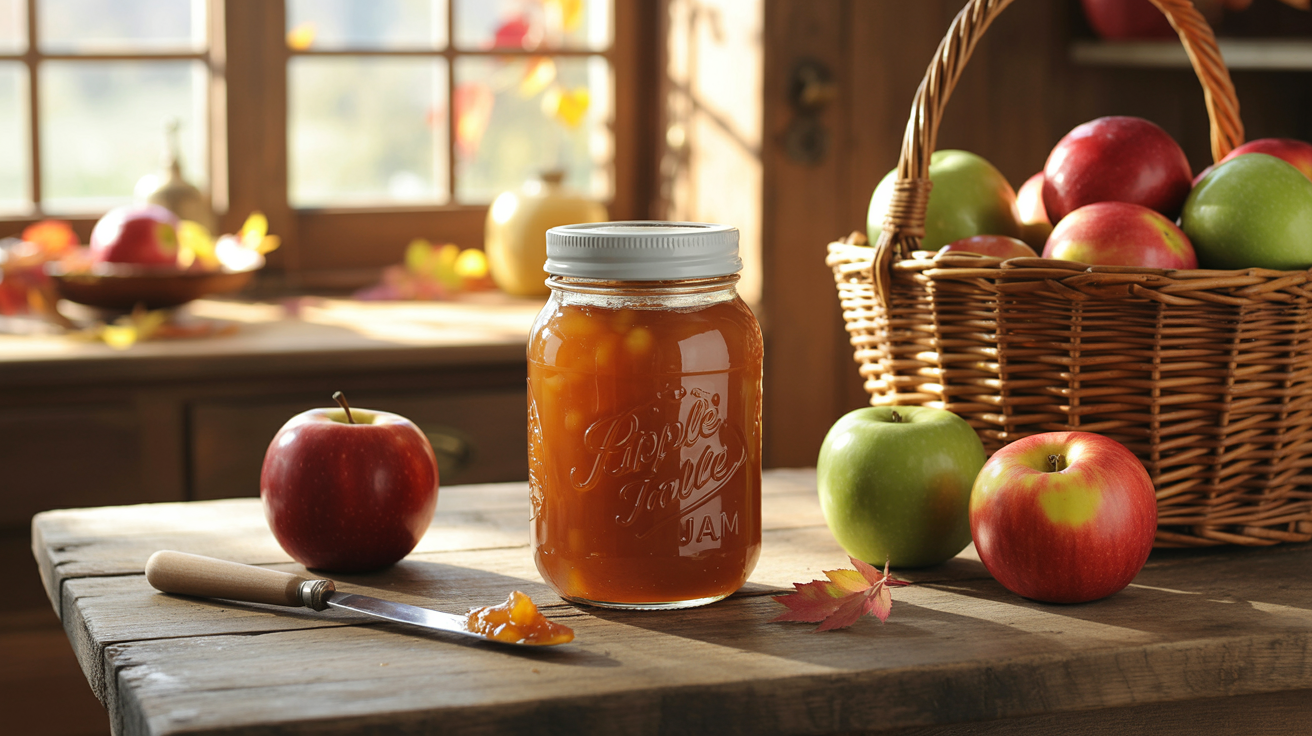
Are the Best Apples for Dehydrating Also the Best for Apple Butter?
Not necessarily.
This is where things get interesting because we’ve already covered apple varieties for another preservation method.
When I’m thinking about apple butter, I’m looking for fruit that cooks down into a flavorful, smooth spread.
The apples are softened through cooking, and their final texture changes dramatically.
Dehydrating is different.
You’re trying to remove moisture while preserving the apple in slices or rings.
That means firm texture becomes especially useful during preparation.
Some varieties can perform well for both purposes.
Fuji, Gala, Granny Smith, and Honeycrisp are all versatile apples.
But the ideal choice depends on what you’re making.
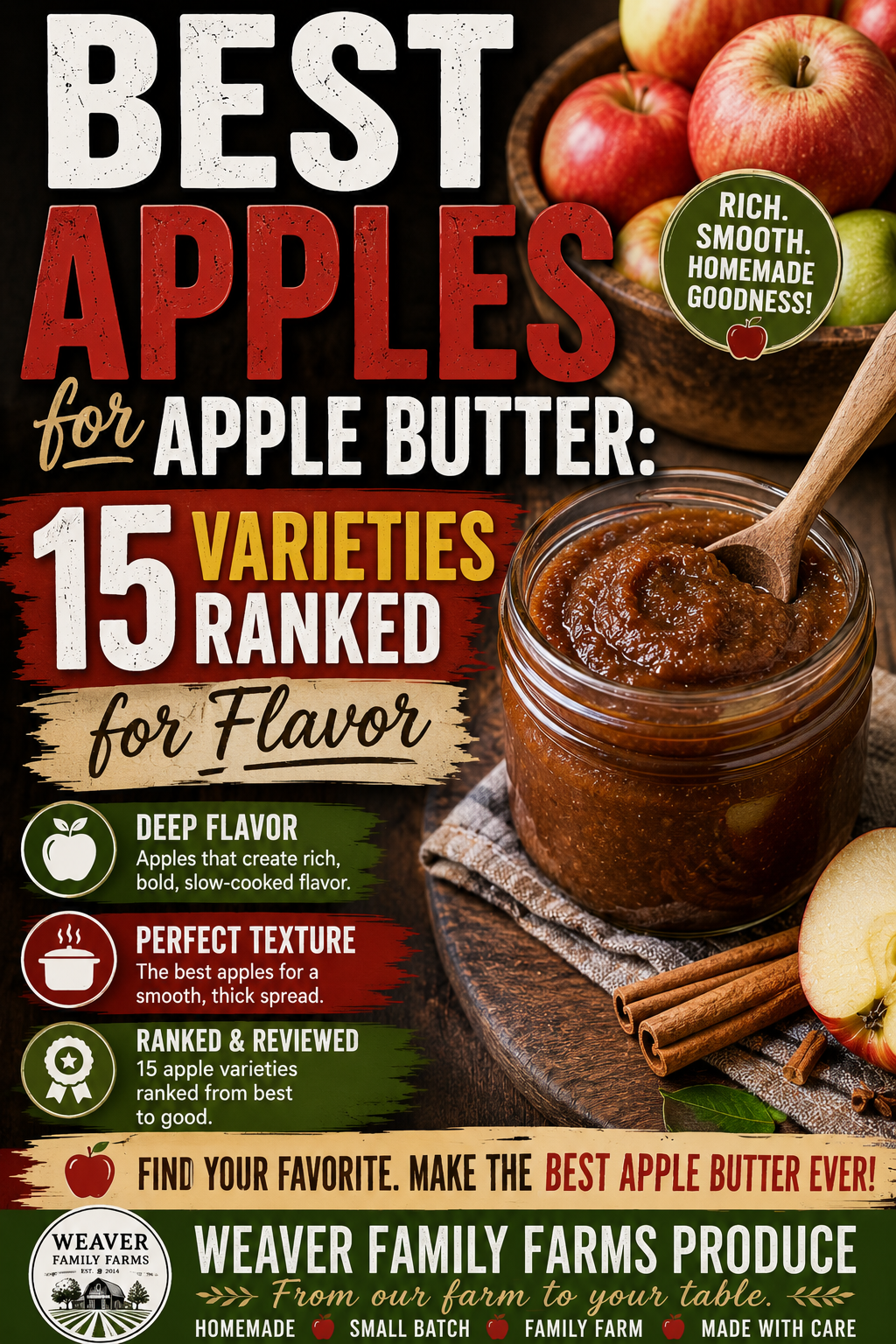
I’ve already covered this from another angle in our guide to the best apples for homemade apple butter.
It’s worth comparing the two because the same apple harvest can be divided among several preservation projects.

How to Dehydrate Apples at Home
Once you’ve chosen the variety, the next step is preparing the fruit.
The process is straightforward, but the details matter if you want the finished apples to dry evenly and store well.
For the actual drying method, I recommend following research-based food preservation guidance rather than relying entirely on a dehydrator’s preset timer.
Illinois Extension recommends drying apples at approximately 140°F, generally for 6 to 12 hours, depending on slice thickness, the equipment, and the fruit itself.
The endpoint matters more than the clock.
Step 1: Choose Firm, Healthy Apples
Start with mature apples that are in good condition.
Avoid moldy, rotten, or badly deteriorated fruit.
A small superficial blemish is different from rot.
If you’re unsure whether a spot is cosmetic or something more serious, don’t assume every discolored apple is suitable for preservation.

I’ve written about whether apples with black spots are safe to eat, because appearance alone doesn’t always tell you what’s happening beneath the skin.
For dehydrating, I’d prioritize sound fruit without damaged or decaying flesh.
Step 2: Wash the Apples
Rinse apples under clean running water before cutting them.
Gently rub the surface to remove dirt.
Don’t use dish soap or household cleaning products.
Then dry the fruit with a clean towel.
Even if you plan to peel the apples, washing first helps avoid transferring contaminants from the skin to the flesh while cutting.
Step 3: Remove the Core
Use an apple corer or a sharp knife to remove the center.
I would remove the seeds and tough core before dehydrating.
That makes the finished slices much easier to eat.
For apple rings, a corer is particularly convenient because you can cut the apple crosswise into circular slices.
For ordinary slices, you can quarter the apple and remove the core from each section.
Step 4: Decide Whether to Leave the Peel On
Both peeled and unpeeled apples can be dehydrated.
Peeled slices may have a softer, more uniform texture.
Slices with the peel left on retain a little more structure and save preparation time.
I wouldn’t say one method is automatically better.
It’s partly personal preference.
For an initial batch, you could prepare some of each and compare the results.
Step 5: Slice the Apples Evenly
This step makes a bigger difference than people might expect.
If one slice is very thin and another is almost half an inch thick, they won’t dry at the same rate.
The thin piece may be finished while the thick one still contains too much moisture.
Illinois Extension describes several acceptable apple preparations, including rings and slices approximately one-quarter to one-half inch thick.
For a straightforward first batch, I’d aim for consistently thin slices around one-quarter inch.
A mandoline slicer with appropriate hand protection can help, but a sharp knife works too.
The important thing is consistency.
How to Keep Dehydrated Apples From Turning Brown
Freshly cut apples begin browning when their flesh is exposed to oxygen.
That discoloration is largely related to enzymatic reactions.
It’s why you can cut an apple, leave it on the counter, and come back to find the flesh darkening.
Dehydrating doesn’t automatically prevent all browning.
In fact, the appearance can change considerably during the drying process.
Do You Need to Pretreat Apples Before Dehydrating?
Pretreatment is recommended when you want to preserve color and quality.
Illinois Extension recommends using an ascorbic acid treatment or another approved anti-browning preparation before drying apples.
Its guidance describes a 10-minute pretreatment, followed by draining the slices before dehydrating.
You can skip pretreatment, but the apples may become noticeably darker during drying and storage.
Can You Use Lemon Juice Instead?
Lemon juice is commonly mentioned in home drying instructions because it contains acids that can help slow browning.
However, it isn’t interchangeable with every tested ascorbic acid treatment.
For the most predictable results, especially if you’re storing dried fruit for months, I would follow a tested pretreatment formula from an extension service.
And I wouldn’t guess at the concentration.
The appropriate amount depends on the ingredient and preservation method.
What Temperature Should You Dehydrate Apples At?
Around 140°F is a good recommended drying temperature for apples.
Illinois Extension recommends approximately 140°F for dehydrating apple slices, with a general drying time of 6 to 12 hours.
That temperature allows warm air to remove moisture without simply baking the fruit.
It’s important to recognize that food drying isn’t the same as cooking.
You aren’t trying to roast the apples.
You’re trying to remove enough moisture to make them suitable for storage.
Can You Dehydrate Apples at 135°F?
Yes, that temperature falls within the range used by many home fruit-drying guides and equipment manufacturers.
However, for the method discussed here, I’d follow Illinois Extension’s approximately 140°F recommendation.
If your machine offers adjustable settings, you can select the recommended temperature and monitor the apples as they dry.
Should You Use a Higher Temperature to Finish Faster?
I wouldn’t automatically increase the temperature just to save time.
Excessively high heat can cook the outside of the fruit before moisture has been removed evenly.
Drying should be controlled and thorough.
It’s better to allow adequate drying time than to rush the process and end up with slices that seem dry on the outside but retain moisture in the center.
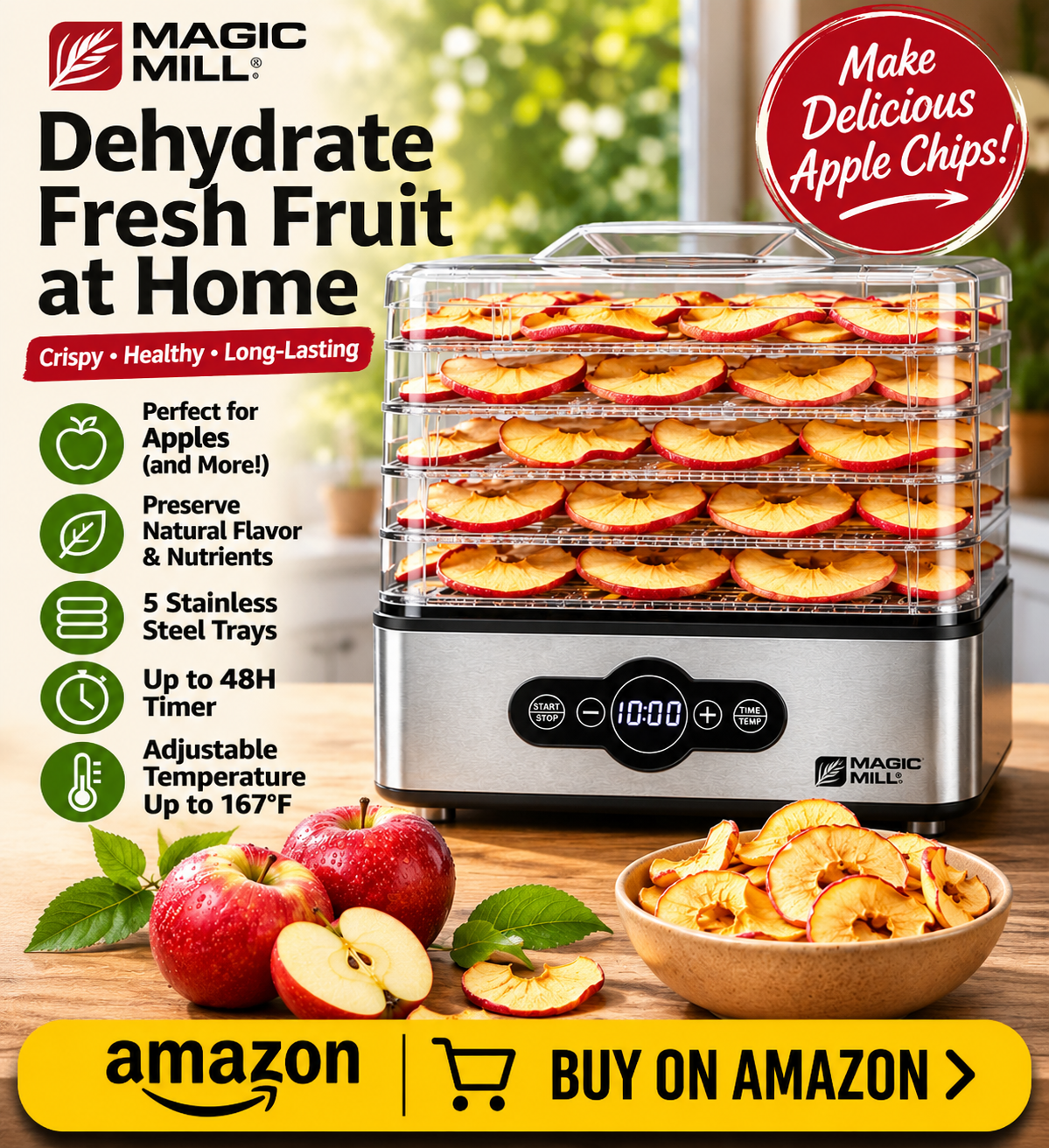
A Food Dehydrator I’d Consider for Apples
You don’t need the most expensive dehydrator on the market to start drying apples.
But I would look for a machine with adjustable temperature control, decent airflow, removable trays, and enough capacity for the amount of fruit you typically prepare.
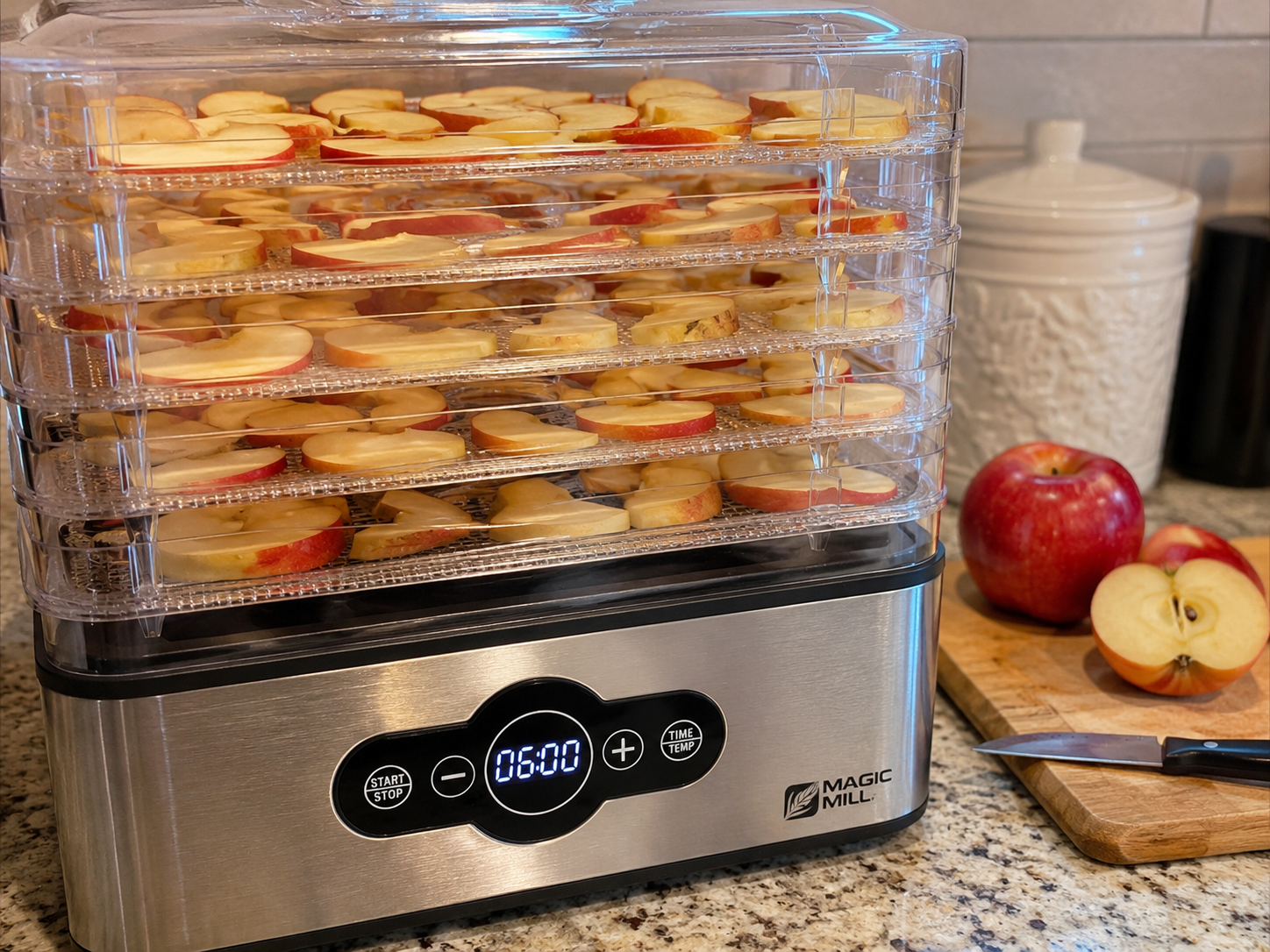
One option worth looking at is the Magic Mill Food Dehydrator Machine with five stackable stainless steel trays.
The model you’ve selected has adjustable temperature controls and a digital timer, making it suitable for drying apple slices as well as other fruits and foods.
The five-tray design is especially practical for someone who wants to dry several apples at once without purchasing a much larger commercial machine.
You can check out the Magic Mill Food Dehydrator on Amazon to see its current details and availability.

I haven’t personally completed a controlled drying test with this exact model, so I wouldn’t claim it produces the best apple chips or dries faster than other machines.
What appeals to me about the design is the ability to adjust the temperature and use multiple trays while following established food-drying guidance.
Why Adjustable Temperature Matters
Different foods have different drying requirements.
A machine that lets you select the temperature is more useful than one that operates at only a single fixed setting.
For apples, you want to be able to use a temperature appropriate for fruit drying.
A timer is helpful too, but I wouldn’t rely on the timer alone to decide whether the apples are finished.
Their actual dryness is what matters.
How Long Does It Take to Dehydrate Apples?
For apple slices approximately one-quarter inch thick, 6 to 12 hours at around 140°F is a reasonable general guideline.
Some batches will finish sooner.
Others may take longer.
Several factors affect drying time.
Slice Thickness
Thin slices usually dry faster than thick ones.
If you want more uniform results, cut the slices as evenly as possible.
Apple Variety
Different apple varieties have different moisture levels and flesh characteristics.
A particularly juicy apple may behave differently from a drier, firmer one.
Dehydrator Airflow
Good airflow helps carry moisture away from the fruit.
A dehydrator should circulate warm air through and around the trays.
If the manufacturer’s directions recommend rotating trays, follow that guidance.
How Full the Trays Are
Overcrowding the trays can interfere with airflow.
I’d arrange slices in a single layer without overlapping them.
Even if you have a large harvest, don’t try to force too much fruit into one batch.
Room Conditions
Humidity and room temperature can influence how efficiently a dehydrator removes moisture.
Here in Missouri, summer humidity is something we’re all familiar with.
That’s one reason an electric food dehydrator is more practical for me to recommend than relying on outdoor sun drying.
Illinois Extension specifically does not recommend sun drying apples in Illinois because of the regional climate, and our humid Midwest conditions raise similar concerns.
How Do You Know When Dehydrated Apples Are Done?
This is one of the most important parts of the entire process.
Don’t assume the apples are finished just because the dehydrator has been running for eight hours.
And don’t judge them solely by how they look while they’re still hot.
The texture changes as the slices cool.
Properly Dried Apples Should Be Leathery
Illinois Extension describes properly dried apples as soft, pliable, and leathery, without a moist area in the center.
A properly dried slice should bend without feeling wet or sticky.
When folded, it shouldn’t stick to itself because of retained moisture.
If the center is still noticeably moist, the apple needs more drying.
Do Dried Apples Have to Be Crunchy?
No.
This is where the difference between dried apple rings and crispy apple chips matters.
Traditional dried apple slices can be chewy and pliable.
They don’t have to snap like a potato chip.
Some people prefer crisp apple chips, which generally require thinner slices and a drier finished texture.
But I’d be careful not to assume that a crispy outside means the center is thoroughly dried.
The fruit still needs to reach the appropriate dryness throughout.
Why Are My Dehydrated Apples Still Sticky?
Sticky apple slices may indicate that they haven’t dried enough.
However, fruit naturally contains sugars, so the exact surface texture can vary.
I’d check the inside of the thickest pieces.
If the center feels noticeably moist, return the slices to the dehydrator.
Don’t seal partially dried fruit into jars and assume it will finish drying in storage.
That can create conditions where mold develops.
Why Are Some Slices Finished Before Others?
This is extremely common when pieces vary in thickness.
Airflow differences within a dehydrator can also affect drying.
If some pieces are ready before others, remove the finished slices and allow the remaining ones to continue drying.
There’s no reason to overdry an entire batch just because a few thick slices still need more time.
Don’t Skip Conditioning Your Dried Apples
This is a step I think a lot of beginners overlook.
Once your apples are fully dried and cooled, they need to be conditioned before long-term storage.
Conditioning helps equalize the remaining moisture among the pieces.
Even if every slice looks dry, some may contain slightly more moisture than others.
The National Center for Home Food Preservation recommends conditioning dried fruit for 7 to 10 days.
How to Condition Dehydrated Apples
- Allow the dried apple slices to cool.
- Place them loosely into clean, food-safe glass or plastic containers.
- Close the containers.
- Let them stand for 7 to 10 days.
- Shake the containers daily to redistribute the fruit.
- Check carefully for moisture or condensation.
- If condensation appears, return the fruit to the dehydrator for additional drying.
This process doesn’t replace proper drying.
It’s an additional step to help ensure the moisture is distributed more evenly before the fruit goes into long-term storage.
If mold develops, discard the affected food rather than trying to dry it again.
How to Store Dehydrated Apples So They Stay Good
After the apples have been dried and conditioned, proper storage becomes the next priority.
You want to protect them from moisture, air, heat, and light.
Use Airtight Containers
Clean glass jars are a useful option because you can see what’s happening inside.
Food-safe airtight containers and suitable moisture-resistant packaging can also work.
The goal is preventing the dried apples from absorbing moisture from the air.
Store Them Somewhere Cool and Dark
I’d choose a cool pantry or another suitable storage area away from direct sunlight and heat.
The National Center for Home Food Preservation notes that storage temperature affects how long dried foods maintain quality.
Warmer storage conditions shorten their useful shelf life.
Label the Containers
I would write down the apple variety and the date the fruit was dried.
If you’re comparing Fuji, Gala, and Granny Smith, separate labels will help you remember which batch you enjoyed most.
That’s especially useful when you want to repeat the process the following season.
How Long Do Dehydrated Apples Last?
Properly dried and packaged apples can remain good for months.
Illinois Extension recommends using dehydrated apples within approximately one year for best quality when kept in suitable cool, dry storage.
For longer storage, freezing the properly dried fruit in appropriate packaging can help preserve quality.
The exact shelf life depends on how thoroughly the apples were dried, whether they were conditioned, how they were packaged, and the conditions where they’re stored.
I wouldn’t simply write an expiration date on a jar and assume the contents will be fine until that day.
Check stored dried fruit periodically.
If you see moisture collecting inside a container, the fruit may not have been dry enough.
If mold appears, discard it.
Can You Dehydrate Apples Without Peeling Them?
Absolutely.
You can leave the peel on apple slices when dehydrating.
The key is washing the apples properly and removing the core.
Some people prefer the texture of peeled dried apples.
Others enjoy leaving the peel attached.
If you’re drying apples from your own trees, leaving the peel on can also save quite a bit of preparation time.
For a first batch, I would compare peeled and unpeeled slices using the same apple variety.
That way, you’ll know whether the difference matters to you.
Can You Dehydrate Apples Without Adding Sugar?
Yes, and that’s one of the reasons I like the idea of making dried apples at home.
You don’t need to coat the slices in sugar to produce a flavorful snack.
Sweet varieties such as Fuji and Gala already contain natural sugars.
When water is removed, the existing sweetness becomes more concentrated.
That said, dried fruit isn’t sugar-free.
The sugars naturally present in the apples remain.
It’s simply possible to make the snack without adding more.
Should You Add Cinnamon Before Dehydrating Apples?
You can.
Cinnamon is a popular flavoring for dried apple slices.
I would begin with a light coating rather than adding so much that you can’t taste the apple itself.
And I wouldn’t automatically sweeten the slices.
If you’re using Fuji or Gala, you may find the natural flavor is enough.
One interesting experiment would be preparing two trays of the same variety.
Leave one plain.
Add a little cinnamon to the other.
Then compare the finished results.
That would tell you more about your personal preference than simply assuming every dried apple needs seasoning.
Can You Dehydrate Apples That Are Starting to Get Soft?
It depends on their condition.
A slightly softer but otherwise sound apple may still be usable.
However, I wouldn’t make badly overripe or mealy apples my first choice.
Firm apples are easier to cut evenly and generally make better starting material for drying.
I also wouldn’t try to save apples that are moldy, rotten, or fermenting.
Dehydration is a preservation method, not a way to reverse spoilage.
For apples that are still fresh but beginning to lose their crispness, another option may be cooking them into something like applesauce or apple butter.
That’s one reason I think having several preservation methods available is useful.
You can choose the method that best suits the fruit’s current condition.
Can You Use Apples With Small Blemishes?
Sometimes, but you need to know what caused the blemish.
A superficial cosmetic mark isn’t necessarily the same as decay.
For example, some apple skin spotting is related to harmless surface conditions.
Other spots may be associated with disease or damaged flesh.
I wouldn’t automatically throw away every apple with an imperfect appearance.
But I also wouldn’t recommend cutting away visible mold and then dehydrating the rest.
For dried fruit, start with sound apples.
If the affected area is questionable, discard the apple rather than risk preserving spoiled fruit.
Is a Dehydrator Better Than an Oven for Drying Apples?
For someone who plans to dry apples regularly, I would generally favor a dedicated food dehydrator.
A dehydrator is built specifically to circulate warm air around food over an extended period.
That makes it convenient for removing moisture at controlled temperatures.
Advantages of a Food Dehydrator
A dedicated dehydrator typically offers adjustable temperatures, multiple drying trays, and airflow designed for drying food.
It also allows you to dry fruit without tying up your main kitchen oven for many hours.
For smaller batches, a compact countertop model may be all you need.
If you’re considering one, the five-tray Magic Mill dehydrator for homemade fruit snacks is an option to compare with your available kitchen space and expected batch sizes.
Can You Dehydrate Apples in an Oven Instead?
Yes, if your oven can maintain an appropriately low drying temperature.
Illinois Extension recommends approximately 140°F to 150°F for oven drying and notes that airflow is important.
Some ovens don’t go that low.
Others may require adjustments to allow moisture to escape.
Always follow current food preservation directions and your oven manufacturer’s safety instructions.
I wouldn’t assume every oven is equally suitable.
For someone planning to preserve fruit regularly, a dedicated dehydrator is usually the more convenient option.
What Else Can You Dehydrate Besides Apples?
Once you have a dehydrator, apples aren’t the only food worth considering.
Depending on the equipment and an appropriate tested drying method, you can dry several types of produce.
Peaches, pears, berries, herbs, and certain vegetables are common candidates.
We grow several of those fruits here at Weaver Family Farms.
One thing I’d want to emphasize, though, is that different foods need different preparation and drying instructions.
Don’t assume that the time and temperature appropriate for apple slices will be right for every other food.
Meat jerky, in particular, requires additional food safety steps and should follow a tested process.
The Magic Mill food dryer with adjustable settings is marketed for several types of food, but each project still needs the appropriate preparation and safety guidance.
Frequently Asked Questions About Dehydrating Apples
What is the best apple for dehydrating?
Fuji, Gala, Honeycrisp, and Granny Smith are all strong choices. Illinois Extension specifically recommends these varieties for drying. Fuji and Gala are sweeter, while Granny Smith offers a tart flavor.
Which apples make the sweetest dried apple chips?
Fuji and Gala are good starting choices because of their naturally sweet flavor. The final sweetness also depends on the fruit’s ripeness and drying conditions.
Are Honeycrisp apples good for dehydrating?
Yes. Honeycrisp is included among the apple varieties recommended by Illinois Extension for dehydrating.
Can you dehydrate Granny Smith apples?
Yes. Their firm texture and tart flavor make them an appealing choice for dried apple slices.
Do you need to peel apples before dehydrating?
No. Apples can be dried with or without the peel. Wash them thoroughly and remove the core before slicing.
What temperature should I use to dehydrate apples?
Approximately 140°F is recommended by Illinois Extension for drying apples.
How long does it take to dehydrate apple slices?
A general guideline is 6 to 12 hours at approximately 140°F, although actual drying time depends on thickness, variety, airflow, and conditions.
Should dehydrated apples be crunchy or chewy?
Properly dried apple slices are often pliable and leathery. Very thin apple chips may be crisper, but it’s important that no moist center remains.
Why did my dehydrated apples turn brown?
Browning can occur when cut apple flesh reacts with oxygen. An approved ascorbic acid pretreatment can help preserve color.
Do dehydrated apples need to be refrigerated?
Properly dried, conditioned, and packaged apples can be stored in a cool, dry place. Refrigeration or freezing may be useful for longer storage or in warm, humid conditions.
How do you keep dried apples from getting moldy?
Dry them thoroughly, condition them for 7 to 10 days, and store them in moisture-resistant packaging. If you find condensation during conditioning, return the fruit to the dehydrator. Discard moldy fruit.
Can you dehydrate apples without sugar or cinnamon?
Absolutely. Plain apple slices can be dehydrated without adding either ingredient.
Are dried apples healthier than candy?
Unsweetened dried apples can be a useful fruit-based snack, but they’re also a concentrated source of natural sugar and calories because much of the water has been removed. Portion size still matters.
Can you use an apple dehydrator for other fruits?
Yes. Many food dehydrators can dry different fruits, but you should follow the correct preparation and drying guidelines for each type.
What I’d Remember Before Drying a Big Apple Harvest
If I were getting ready to dehydrate a large basket of apples, I’d pay the most attention to choosing good fruit and keeping the slices consistent.
I wouldn’t assume the most expensive apple would automatically make the best dried snack.
Fuji and Gala are great places to begin if you enjoy sweetness.
Granny Smith is worth trying if you like tartness.
And Honeycrisp is another excellent option when you already have the fruit available.
For someone growing apple trees at home, I think one of the biggest advantages of dehydrating is having another way to use a harvest instead of relying entirely on fresh eating, refrigeration, or cooking everything into preserves.
You can take several pounds of fresh fruit, remove much of its moisture, and turn it into something that’s considerably easier to store.
Just make sure you’re drying the slices thoroughly, conditioning them properly, and keeping them protected from moisture afterward.
The apple variety determines a lot of the flavor.
But the preparation and storage are what help you end up with dried apples worth keeping.
About the Author
Daxon Weaver is the owner of Weaver Family Farms Produce, part of Weaver Family Farms in Missouri. He and his family grow apples, peaches, pears, pawpaws, Honey Jar and Sugar Cane jujubes, hardy kiwi, berries, and other fruit crops in USDA Zone 6a. He shares practical farm experiences and research-backed advice about harvesting, storing, preserving, and enjoying homegrown fruit.