When most people hear that we’re growing kiwi on our Missouri family farm, I can almost picture what comes to mind.
Those big, brown, fuzzy kiwis sitting in the produce section at Walmart.
And I understand why. That’s the kind of kiwi most Americans recognize.
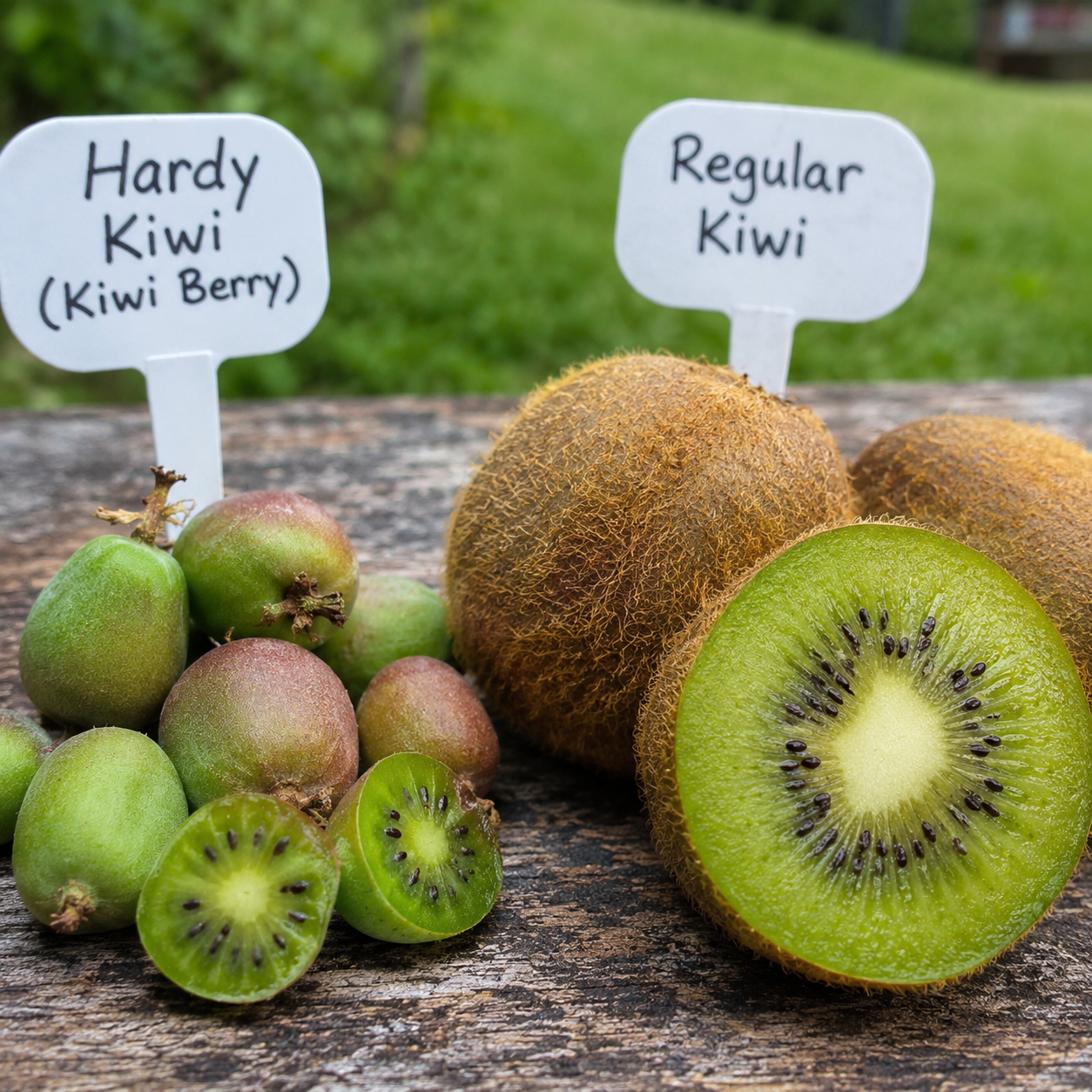
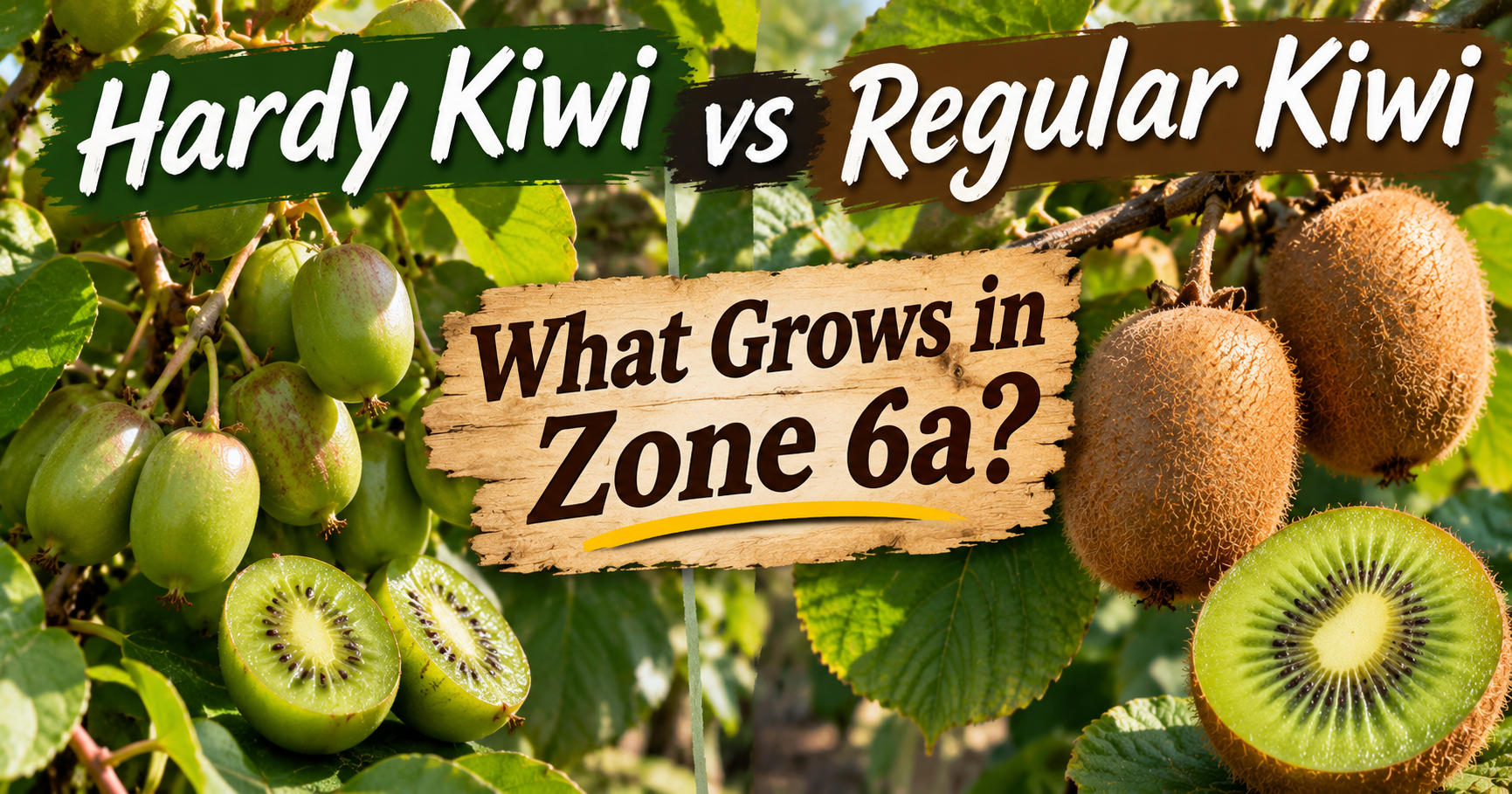
But the kiwi vines we’re growing here in USDA Zone 6a are a little different. They’re known as hardy kiwi, and instead of producing those large fuzzy fruits, they grow smaller kiwis that often look more like oversized grapes.
They’re also much better suited to the cold winters we experience here in Missouri.
We’ve planted hardy kiwi varieties including Ken’s Red, Issai, and Meader, and I’m looking forward to seeing how they develop as the vines mature. Some of our fruit plants are still getting established, so I’m not going to pretend we’ve already harvested baskets of kiwi berries or know exactly how each variety performs on our property.
What I can do is explain why we chose cold-hardy varieties, what makes them different from grocery-store kiwis, and what I’ve learned about growing fruit in a climate where winter temperatures can be pretty unforgiving.
If you’re thinking about planting kiwi in Missouri, Kansas, Illinois, Iowa, or another part of the Midwest, the type of kiwi you choose matters more than you might realize.
Can You Really Grow Kiwi in Missouri Zone 6a?
Yes, you can grow kiwi in Missouri Zone 6a, provided you choose varieties suited to the climate.
That’s the important distinction.
Not every kiwi vine sold online is equally cold-hardy.
The large fuzzy kiwis most people recognize belong primarily to Actinidia deliciosa, while common hardy kiwi berries belong to Actinidia arguta or related varieties and hybrids.
Those botanical differences matter because they affect winter survival, fruit size, appearance, and growing requirements.
Michigan State University Extension identifies hardy kiwi and Arctic kiwi as the types most suitable for much of the Midwest. The familiar large fuzzy kiwi isn’t reliably winter-hardy in the region.
Here on our farm, we don’t have the luxury of assuming every tropical-looking fruit will survive outside.
Our winters can bring freezing temperatures, ice, snow, and periods of bitter cold.
That’s why I pay attention to USDA hardiness ratings before deciding which varieties to plant.
But even those ratings don’t tell the whole story.
A kiwi vine might survive winter temperatures just fine and still lose its fruit crop to a late spring freeze.
I’ll explain that difference because it’s one of the biggest things new hardy kiwi growers need to understand.
What Is a Hardy Kiwi?
Hardy kiwi is a cold-tolerant climbing vine that produces small, smooth-skinned edible fruit.
The fruit is commonly called a kiwi berry.
Unlike the fuzzy kiwis sold in grocery stores, most hardy kiwi berries can be eaten whole without peeling.
That means the skin, flesh, and tiny seeds are all part of the eating experience.
The fruit is generally much smaller than a traditional kiwi.
Many varieties produce fruit roughly the size of a large grape or small plum, although size varies by cultivar.
The vines themselves are vigorous, woody, and perennial.
That last part is important.
Hardy kiwi isn’t a small little garden plant that stays neatly contained in one corner.
A mature vine can become surprisingly large and heavy.
It needs adequate room, strong support, and regular attention to pruning.
What Is the Difference Between Hardy Kiwi and Regular Kiwi?
There are several differences worth understanding before you plant anything.
Hardy Kiwi Is Much More Cold-Tolerant
This is the biggest reason we’re growing it here.
Many hardy kiwi cultivars are adapted to regions with cold winters and can survive temperatures considerably below freezing once established and properly dormant.
The exact tolerance depends on the variety.
For example, some hardy kiwi cultivars are rated for USDA Zone 5 or colder, while others, including Issai and Ken’s Red, are commonly listed for Zone 6 and warmer.
That doesn’t mean every hardy kiwi plant will survive every winter without damage.
A young vine that hasn’t developed a strong root system may be more vulnerable than an established plant.
But the overall cold tolerance is substantially better than the common large fuzzy kiwi.
Regular Kiwi Is Much Larger
The fuzzy kiwis sold at grocery stores are considerably larger than most hardy kiwi berries.
A regular kiwi is often large enough that you cut it in half and scoop the flesh out with a spoon.
Hardy kiwi berries are usually small enough to eat whole.
That’s one thing I find appealing about them.
Instead of cutting and peeling every fruit, you can enjoy them much more like grapes.
Hardy Kiwi Doesn’t Have the Familiar Fuzzy Skin
This is probably the easiest way to tell the two apart.
The traditional green kiwi has a brown skin covered in fine fuzz.
Hardy kiwi berries generally have smooth skin.
Depending on the variety, the skin may be green, reddish, or have a blush of another color.
Some varieties have green flesh, while others develop reddish coloring inside.
The Flavor Can Be Different
Hardy kiwi berries are often described as sweet, aromatic, and similar to conventional kiwi, sometimes with additional tropical or berry-like notes.
Different varieties have different flavor characteristics.
That’s something I’m especially interested in comparing once our vines begin producing a worthwhile harvest.
Our Ken’s Red, Issai, and Meader plants should give us opportunities to learn more about the differences between cultivars, although a male Meader vine would serve as a pollinizer rather than produce fruit.
For now, I’d rather explain what established growing research says than invent a taste comparison we haven’t completed ourselves.
Why We Chose Hardy Kiwi for Our Missouri Farm
Our orchard is becoming a pretty interesting collection of fruit.
We grow apples, peaches, pears, jujubes, pawpaws, persimmons, mulberries, several kinds of berries, and other less-common fruits.
Some are already producing.
Others are still young and getting established.
Part of the fun is figuring out which unusual fruits can actually handle our climate.
That’s where hardy kiwi caught my attention.
I like trying fruits that most people around here don’t commonly grow, especially when they’re something our family might eventually be able to harvest and enjoy fresh.
But I also want plants that have a realistic chance of surviving our winters.
Planting the tropical-looking fuzzy kiwi from a grocery store would be a much riskier experiment.
Growing cold-hardy kiwi varieties makes considerably more sense.
The Hardy Kiwi Varieties We’re Growing
One thing I want to make clear is that hardy kiwi isn’t just one variety.
There are several cultivars, and they don’t all produce identical fruit or have the same growth habits.
Here are the ones relevant to our orchard.
Ken’s Red Hardy Kiwi
Ken’s Red is one of the more interesting hardy kiwi cultivars because of its fruit color.
While many kiwi berries have green flesh, Ken’s Red can develop reddish-purple coloring inside as it ripens.
The fruit may also develop reddish tones on the skin.
It’s considered a vigorous female cultivar and generally needs a compatible male kiwi vine for reliable pollination.
Oregon State University describes Ken’s Red as a hybrid involving Actinidia arguta and Actinidia melanandra.
This is one of the varieties I’m especially interested in seeing mature.
Red-fleshed kiwi berries aren’t something most people would expect when they hear the word kiwi.
And if our vine eventually produces a good crop, I’d love to compare the fruit with the green-fleshed varieties growing nearby.
Issai Hardy Kiwi
Issai is particularly interesting because it’s commonly described as self-fertile.
That means it can produce fruit without requiring a separate male kiwi plant in the same way most female hardy kiwi cultivars do.
However, having a compatible male nearby can improve fruit set or fruit size.
Issai is also generally less vigorous than many other hardy kiwi varieties.
That doesn’t mean it stays tiny.
It still needs a suitable growing area and support.
But it may be more manageable than some of the extremely vigorous cultivars.
Its fruit is typically green, smooth-skinned, and smaller than that of some other hardy kiwi varieties.
Oregon State University notes that Issai can ripen somewhat unevenly within its fruit clusters.
That’s worth remembering if you’re expecting to harvest everything on the same day.
Meader Hardy Kiwi
Meader is another name you’ll encounter when shopping for hardy kiwi plants.
But here’s something I think is important.
Meader can refer to male or female hardy kiwi selections, so you need to check the exact plant you purchased.
If you have a male Meader, its primary job is producing pollen for compatible female vines.
It won’t produce the edible kiwi berries you’re hoping to harvest.
If you have a female Meader, fruit production depends on having appropriate pollination.
That’s why I’m not going to automatically describe our Meader plant as a fruit-producing female until we’ve confirmed its label.
The distinction may sound minor, but it could explain why someone grows a beautiful kiwi vine for several years and never gets a single fruit.
Do You Need Both Male and Female Hardy Kiwi Vines?
For most hardy kiwi varieties, yes.
This is one of the most important things to understand before planting.
Most hardy kiwi vines are either male or female.
Female vines produce the fruit.
Male vines provide pollen.
Without a compatible pollen source, many female vines won’t produce a worthwhile crop.
A single male vine can often pollinate several nearby female vines, provided they’re compatible and their flowering periods overlap.
The exact number depends on the planting arrangement and cultivar.
What About Issai Being Self-Fertile?
Issai is the exception many home growers are interested in.
It can produce fruit without a separate male vine.
That makes it appealing when you don’t have room for several kiwi plants.
However, self-fertile doesn’t necessarily mean it will always produce the heaviest possible crop alone.
A compatible male pollinizer can still be beneficial.
Can a Male Hardy Kiwi Pollinate a Regular Fuzzy Kiwi?
I wouldn’t assume so.
Different kiwi species and cultivars have different pollination compatibility and flowering schedules.
If you’re growing several types, choose pollinizers specifically recommended for your female cultivar.
Simply having two kiwi vines doesn’t guarantee successful fruit production.
How Long Does It Take Hardy Kiwi to Produce Fruit?
This is one area where patience really matters.
Hardy kiwi vines may take several years before producing their first crop.
Penn State Extension notes that many hardy kiwi vines don’t bear fruit until they’re approximately five to nine years old, although other extension sources report earlier bearing under favorable conditions and with certain cultivars.
Issai may begin producing earlier than more vigorous varieties.
But I wouldn’t promise someone a full harvest in the first or second season.
We already grow several different kinds of fruit here on our farm, and one thing I’ve learned is that planting a fruit tree or vine doesn’t mean you’re immediately going to be filling buckets.
Sometimes the plant needs several seasons to establish itself.
That’s simply part of growing fruit.
Hardy Kiwi Vines Need Much Stronger Support Than People Expect
This is probably one of the biggest things I’d warn new growers about.
A hardy kiwi vine can become extremely vigorous.
Some varieties can produce substantial amounts of new growth in a single growing season.
That’s a lot different from a small garden vine you can leave on a lightweight decorative trellis.
I would plan for a sturdy structure from the beginning.
What Kind of Trellis Works Best?
A strong T-bar trellis, substantial arbor, or well-built pergola can work.
The important thing is supporting the weight of mature vines and eventually the fruit.
The structure should also provide room for pruning, training, and harvesting.
A flimsy garden arch may look beautiful when the plant is young, but it may not support the vine once it’s established.
Can Hardy Kiwi Grow on a Fence?
Possibly, but I would be selective about the fence.
A strong, purpose-built support may work.
A lightweight residential fence could become overwhelmed by the weight and growth of a mature vine.
I also wouldn’t want kiwi growing through areas where it would be difficult to prune or harvest.
If I were starting a new planting, I’d rather build a proper support system first than spend years trying to correct an unsuitable setup.
How Much Sun Do Hardy Kiwi Vines Need?
Hardy kiwi generally performs best in full sun, although it can tolerate some partial shade.
If fruit production is the goal, I’d prioritize a location that receives plenty of direct sunlight.
That doesn’t mean placing a young vine in the harshest possible location without considering wind, drainage, and frost exposure.
It’s about finding a reasonable balance.
Here in Missouri, summers can get hot.
We also have storms and periods of strong wind.
A protected location with good sunlight and well-drained soil makes sense.
Soil Drainage Is Especially Important
One thing I wouldn’t overlook is drainage.
Hardy kiwi vines need moisture, but they don’t like sitting in waterlogged soil.
Poor drainage can increase the risk of root rot.
That can become a serious problem, especially for young plants.
Issai has also shown greater susceptibility to certain root rot problems in research trials.
I’d avoid planting hardy kiwi in an area where rainwater regularly collects and remains for days.
A well-drained planting location is a much better starting point.
The Biggest Surprise About Hardy Kiwi Cold Hardiness
Here’s something that initially seems contradictory.
Hardy kiwi can tolerate very cold winters.
Yet a late spring frost can still damage it badly.
How does that make sense?
The answer is dormancy.
When the vine is completely dormant during winter, it can tolerate temperatures that would damage many less-hardy plants.
But once warm spring weather encourages new shoots to emerge, those tender shoots become much more vulnerable.
A freeze that wouldn’t bother a dormant vine can damage fresh growth.
What Happens If Spring Frost Damages Hardy Kiwi?
The leaves and tender shoots may turn dark, wilt, or die back.
The vine itself may survive and produce new growth later.
However, damage to developing flowers can reduce or eliminate that year’s fruit crop.
That’s why a plant can be winter-hardy without being guaranteed to produce fruit every season.
For us in Zone 6a, that’s an important distinction.
We can have pleasant spring weather followed by a cold snap that catches everyone off guard.
If you’re choosing a hardy kiwi planting location, don’t just consider winter temperatures.
Pay attention to spring frost exposure too.
When Do Hardy Kiwi Berries Ripen in Missouri?
Hardy kiwi berries generally ripen from late summer into fall, depending on the cultivar and growing conditions.
Here in Missouri Zone 6a, I’d expect the timing to depend on summer heat, rainfall, the variety, and when the vine began growing in spring.
I wouldn’t promise an exact September or October harvest date for every plant.
Some cultivars ripen earlier than others.
And because our kiwi vines are still developing, I want to document their actual harvest timing as they begin producing rather than make up dates from our orchard.
How Do You Know When Hardy Kiwi Berries Are Ripe?
One of the nice things about hardy kiwi is that the fruit can continue ripening after harvest when picked at the proper maturity stage.
A ripe kiwi berry often becomes slightly soft to the touch.
Some varieties develop more translucent-looking skin.
Others may show changes in color or aroma.
But appearance varies by cultivar.
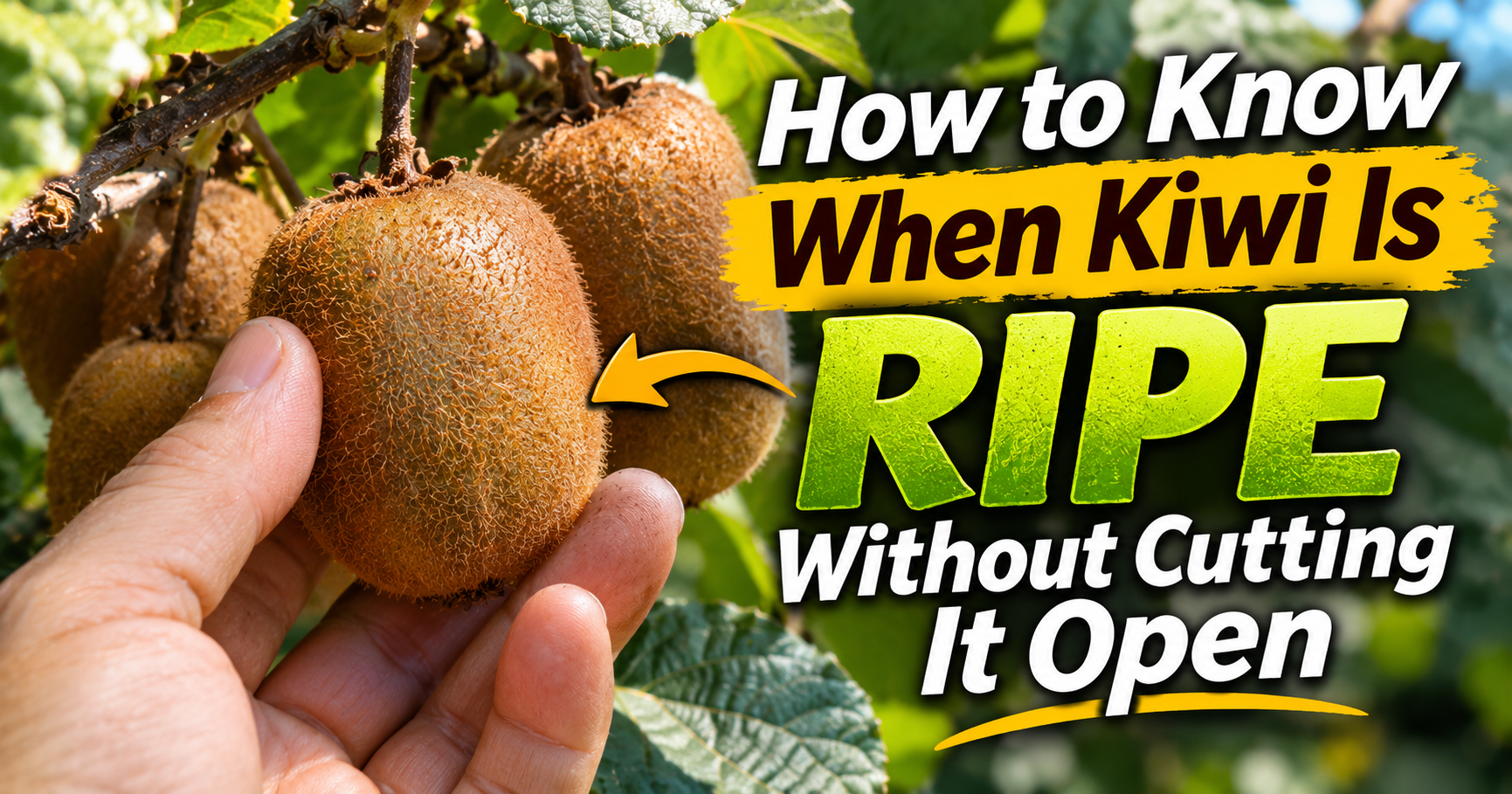
If you want a detailed explanation of kiwi ripeness, including the differences between regular kiwi and hardy kiwi berries, I’ve already written a guide about how to know when kiwi is ripe without cutting it open.
It’s especially useful for understanding why a fruit’s harvest maturity and eating ripeness aren’t always the same thing.
Can You Eat Hardy Kiwi Berries With the Skin On?
Yes.
That’s one of their biggest advantages over regular fuzzy kiwi.
Hardy kiwi berries generally have thin, smooth, edible skin.
You can wash them and eat them whole, similar to grapes.
You don’t normally need to peel them.
Of course, remove any damaged or spoiled fruit and wash sound fruit under clean running water before eating.
Are the Seeds Edible?
Yes.
Like ordinary kiwi, hardy kiwi berries contain numerous tiny edible seeds.
You don’t need to remove them.
That’s quite a contrast to some of the other unusual fruits we grow.
Our pawpaws have large seeds that must be removed before eating, while jujubes have a hard central pit.
Hardy kiwi berries are much simpler to eat fresh.
Is Hardy Kiwi Sweeter Than Regular Kiwi?
It can be, depending on the cultivar and ripeness.
Some hardy kiwi varieties are known for their sweet flavor and strong aroma.
Regular fuzzy kiwis also vary considerably.
A fully ripe green grocery-store kiwi can be sweet and tangy.
Golden kiwi varieties may have a milder, sweeter taste.
And hardy kiwi berries can develop their own distinct balance of sweetness and acidity.
I wouldn’t claim that every hardy kiwi tastes better or sweeter than every regular kiwi.
That would be oversimplifying it.
What excites me is the opportunity to eventually compare our own varieties at the same stage of ripeness.
That’s where growing them yourself becomes particularly interesting.
Are Hardy Kiwi Vines Worth Growing in Zone 6a?
I think they can be, especially if you’re interested in unusual fruit and don’t mind putting some work into the support structure.
But I wouldn’t tell everyone they’re the easiest possible fruit to grow.
There are a few things to consider.
Reasons I Like the Idea of Growing Them
- They’re much better adapted to cold climates than typical fuzzy kiwi.
- Their smooth-skinned fruit can be eaten whole.
- There are several interesting cultivars.
- They can become productive perennial fruit vines.
- They offer something different from ordinary backyard fruits.
Reasons Someone Might Want to Reconsider
- Many cultivars require a compatible male pollinizer.
- The vines can become extremely vigorous.
- They need substantial support.
- Spring frosts can damage tender growth and flowers.
- Some varieties take several years to begin producing.
- Poor drainage can cause serious root problems.
Those aren’t necessarily reasons to avoid hardy kiwi.
They’re reasons to plan ahead.
What I’d Tell Someone Buying Their First Kiwi Vine
If you live in USDA Zone 6a and want to grow kiwi outdoors, I’d start by making sure you’re buying the right kind.
Don’t assume the kiwi plant at a garden center is automatically suited to your climate.
Check the botanical name.
Check the cultivar.
Check whether it’s male, female, or self-fertile.
Then think about how you’re going to support it.
A good trellis should be part of the plan from the beginning, not an afterthought once the vine starts growing everywhere.
I’d also check the planting location for drainage and spring frost exposure.
And finally, I’d be realistic about how long it may take to produce fruit.
There’s nothing wrong with planting something that won’t give you a harvest immediately.
That’s part of building an orchard.
Common Questions About Hardy Kiwi in Zone 6a
Can regular grocery-store kiwi grow in Missouri?
The familiar large fuzzy kiwi isn’t generally a reliable outdoor crop in Missouri Zone 6a. It lacks the dependable cold hardiness of the hardy kiwi varieties better suited to the Midwest.
Is hardy kiwi the same as kiwi berry?
Usually, yes. Kiwi berry is a common name for the small, smooth-skinned fruit produced by several hardy kiwi types.
Can hardy kiwi survive below-zero temperatures?
Many cultivars can tolerate temperatures below zero while fully dormant. The exact tolerance depends on the variety and growing conditions.
Does Issai kiwi need a male plant?
Issai is self-fertile and can produce fruit without a separate male. However, compatible pollen may improve fruit set or size.
Does Ken’s Red need a pollinator?
Yes. Ken’s Red is a female cultivar that generally needs a compatible male kiwi vine for reliable fruit production.
Is Meader kiwi male or female?
Meader is associated with both male and female hardy kiwi selections. Check the exact plant label to confirm which one you have.
Can you grow hardy kiwi in a container?
It’s possible, particularly with less vigorous varieties, but container-grown vines need adequate root space, sturdy support, watering, and extra winter protection. Roots in containers can experience colder temperatures than roots protected by the ground.
Do hardy kiwi vines lose their leaves in winter?
Yes. Hardy kiwi is a deciduous vine. Losing its leaves in fall is normal.
Can hardy kiwi grow without a trellis?
It can climb other structures or even trees, but I wouldn’t recommend growing it without planned support. Mature vines can become large, heavy, and difficult to manage.
How long can a hardy kiwi vine live?
Hardy kiwi vines are long-lived perennials. With suitable care and conditions, established vines may remain productive for many years.
Are kiwi berries sold in grocery stores?
Sometimes, but they’re much less common than ordinary fuzzy kiwi. Their shorter storage and handling characteristics help explain why they’re not available everywhere.
Why I’m Looking Forward to Our First Real Hardy Kiwi Harvest
One thing I enjoy about our orchard is that it isn’t limited to the same few fruits everyone grows.
We have familiar favorites like apples and peaches.
Then we have more unusual crops such as pawpaws, jujubes, persimmons, honeyberries, and hardy kiwi.
Some have already given us memorable harvests.
Others are still growing into their potential.
Hardy kiwi falls into that second category for us.
I’m interested in seeing how Ken’s Red develops its reddish fruit, how Issai performs, and what role our Meader vine plays once we confirm its exact selection.
I’m also curious which variety will handle our Missouri conditions best over time.
That’s the part I don’t want to guess about.
I’d rather share actual observations as the vines mature, including which ones grow most vigorously, when they begin flowering, how the fruit develops, and eventually what each variety tastes like.
For anyone considering growing kiwi in Zone 6a, I think the biggest lesson is simply understanding that the small hardy kiwi berries and the large fuzzy grocery-store kiwis aren’t the same plant.
Once you know that difference, choosing the right vines becomes much easier.
And with the proper varieties, enough room, and a sturdy support system, it’s entirely possible to grow a fruit in Missouri that most people would never expect to see hanging from a backyard vine.
About the Author
Ethan Brooks writes for Weaver Family Farms Produce, sharing practical information about growing, harvesting, storing, and enjoying fruit on a Missouri Zone 6a family farm. The farm grows hardy kiwi alongside apples, peaches, pears, jujubes, pawpaws, berries, and other fruit crops. His articles combine established horticultural research with the farm’s firsthand observations as its younger fruit plantings mature.