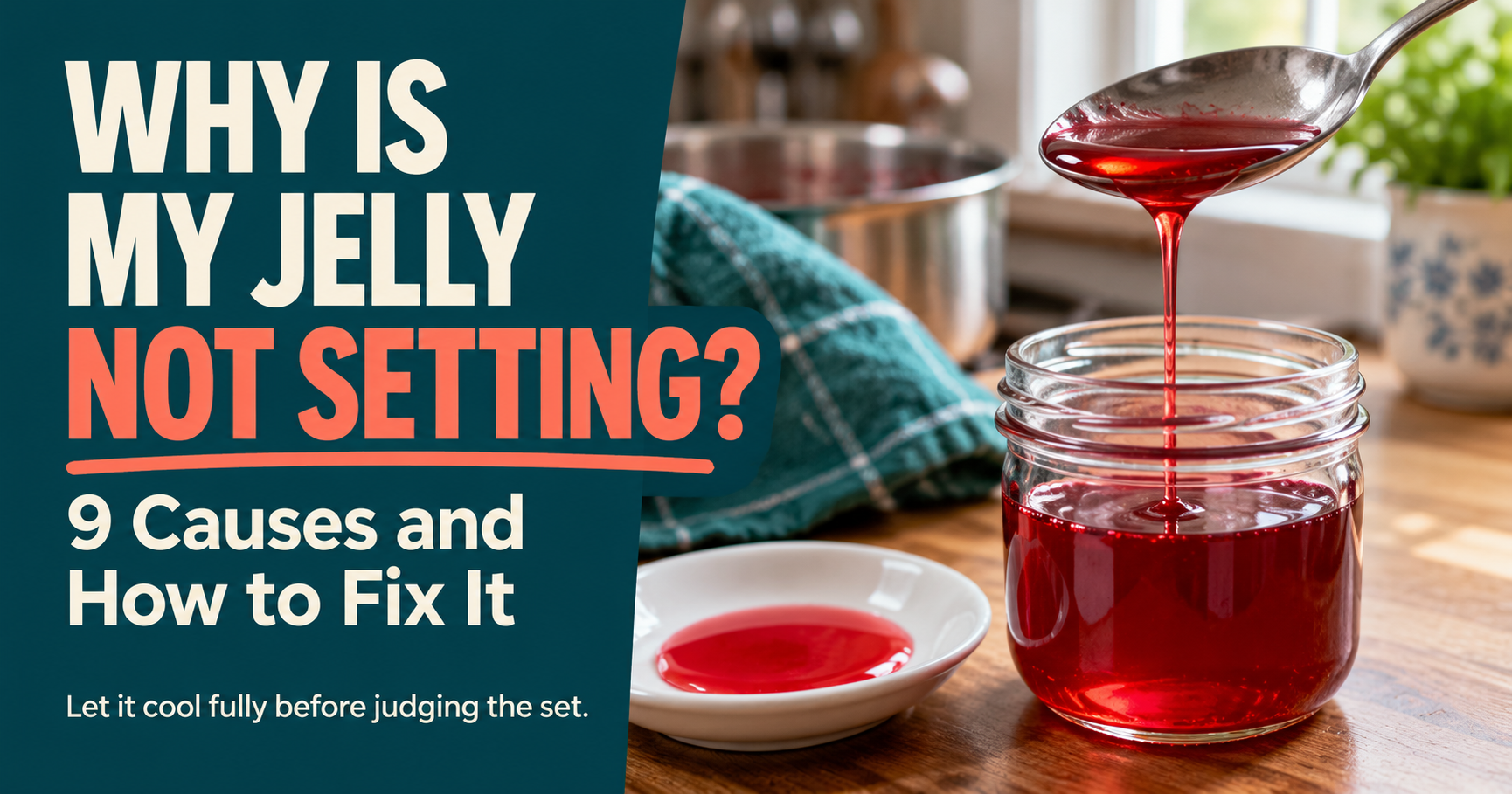
There’s nothing quite as frustrating as spending an afternoon making homemade jelly, carefully filling your jars, and then discovering the next morning that everything is still runny.
You followed the recipe.
You measured the sugar.
You boiled the fruit juice.
You waited for the jars to cool.
And somehow, instead of beautiful, spreadable jelly, you’ve ended up with something that pours like pancake syrup.
If you’ve ever found yourself holding a jar sideways, watching the contents slide around, and wondering what went wrong, I understand the frustration.
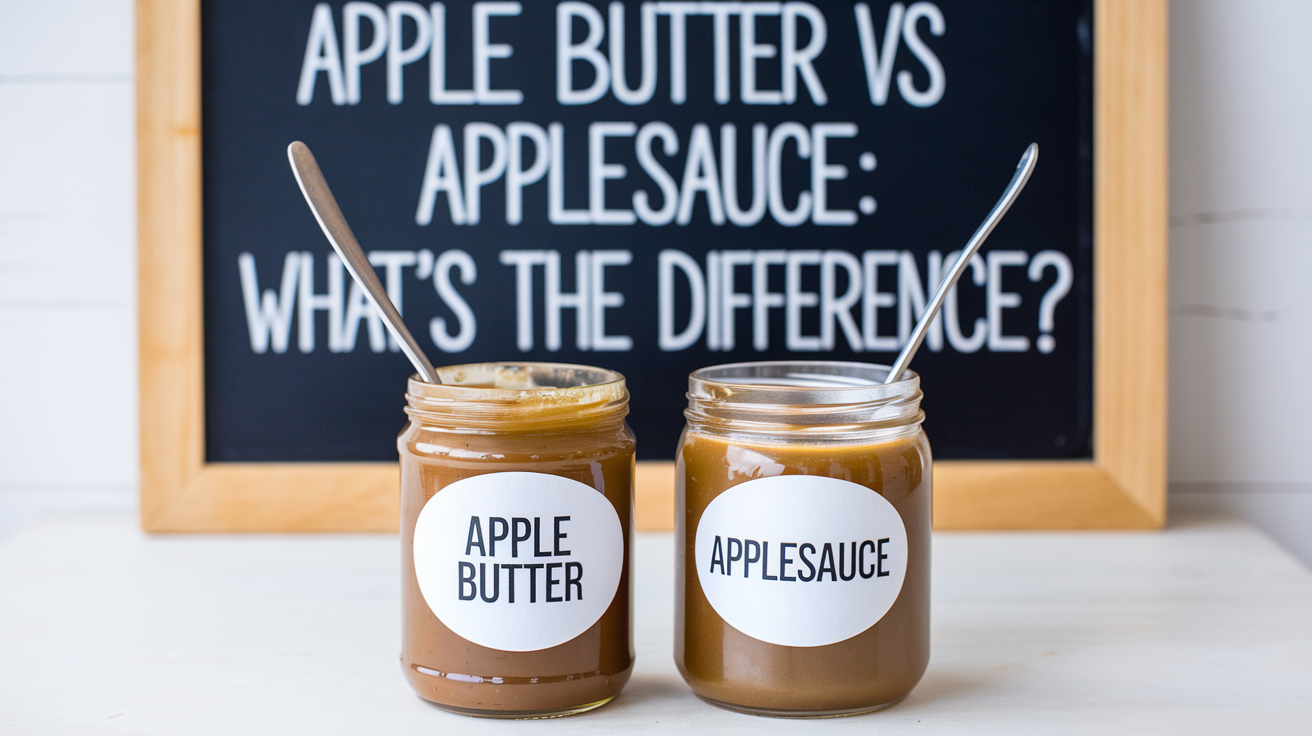
One thing I’ve learned about making fruit preserves is that jelly can be surprisingly particular. Unlike apple butter, which thickens mainly as moisture cooks away, traditional jelly depends on the right balance of pectin, sugar, acid, and cooking.
Get one of those wrong, and the entire batch can struggle to set.
But here’s the encouraging part.
Jelly that doesn’t set isn’t automatically ruined.
Sometimes it simply needs more time. Other times you can remake it using a tested method. And occasionally, the best solution is to use it as a delicious fruit syrup rather than waste perfectly good ingredients.
Here on our Missouri family farm, growing fruit and finding ways to preserve the harvest are important parts of what we enjoy sharing. I want this guide to be useful whether you’re making apple jelly, crab apple jelly, grape jelly, blackberry jelly, or another traditional fruit preserve.
Let’s figure out what happened to your jelly, what you can safely do about it, and how to keep the same problem from happening again.
First, How Long Does Homemade Jelly Take to Set?
Before changing anything, I would ask one simple question.
How long has your jelly been sitting?
If you just finished canning it and the jars have only been cooling for a couple of hours, you might not have a problem at all.
Jelly doesn’t always reach its final consistency immediately after cooking.
As the mixture cools, the pectin network develops and the liquid begins holding together.
Some recipes set relatively quickly. Others take longer.
Traditional jelly made without added pectin can be particularly unpredictable because the amount of natural pectin varies from one batch of fruit to another.
Should You Wait 24 Hours Before Checking?
Yes, I’d generally allow at least 24 hours before deciding that a traditional jelly batch has failed.
But I wouldn’t rush into remaking it after exactly one day, either.
Some properly prepared jelly takes several days to reach its final set. The National Center for Home Food Preservation advises that some jellied products can take as long as two weeks to set.
That doesn’t mean every runny batch will magically thicken after two weeks.
It means you should distinguish between a batch that’s still developing its gel and one that has genuinely failed.
If the jars were processed using a tested shelf-stable canning recipe and have sealed properly, you can follow that recipe’s cooling and setting guidance.
If the jelly wasn’t safely canned, keep it refrigerated. Waiting for a set doesn’t make an improperly processed jar shelf stable.
Why Does Jelly Need Pectin, Sugar, and Acid?
Understanding these three ingredients makes troubleshooting much easier.
I think of them as the foundation of traditional jelly making.
Pectin Creates the Gel
Pectin is a naturally occurring substance found in fruit.
When conditions are right, it forms a network that holds liquid in place.
That’s what turns fruit juice into jelly instead of syrup.
Some fruits naturally contain plenty of pectin.
Others contain much less.
Apples and crab apples can be good sources, especially when they’re mature but not overly ripe.
Strawberries and certain other fruits may need added pectin or a different recipe formulation to set reliably.
Sugar Does More Than Make Jelly Sweet
In traditional high-sugar jelly, sugar isn’t simply there for flavor.
It helps the pectin form a gel by changing how water interacts with the pectin molecules.
That’s why removing a cup of sugar from a regular jelly recipe can cause problems.
If you want less sugar, you need a recipe specifically developed for reduced-sugar jelly, usually using an appropriate type of pectin.
Acid Helps the Pectin Work
Acidity also matters.
Traditional high-methoxyl pectin requires the right acidic conditions to form a good gel.
If the fruit juice isn’t acidic enough, the jelly may remain loose even when you’ve added the correct amount of sugar.
That’s one reason certain recipes call for bottled lemon juice.
I wouldn’t randomly add extra lemon juice to every failed batch, though. The correct adjustment depends on the original recipe and preservation method.
1. Your Fruit Didn’t Have Enough Natural Pectin
This is one of the first things I’d investigate when jelly made without commercial pectin refuses to set.
Different fruits contain different amounts of pectin.
Even within the same fruit, ripeness makes a difference.
For example, apples that are mature but slightly underripe often contain more useful pectin than fruit that’s become extremely soft or overripe.
As fruit ripens, some of its pectin changes and becomes less effective for traditional jelly making.
That means two batches made from the same kind of fruit can behave differently.
What I’d Do Differently Next Time
If I were making apple jelly without added pectin, I’d choose a tested recipe that specifies the appropriate ripeness of the apples.
I’d also avoid using fruit that’s already breaking down.
For crab apples, I’d look for sound, mature fruit rather than waiting until everything is overly soft.
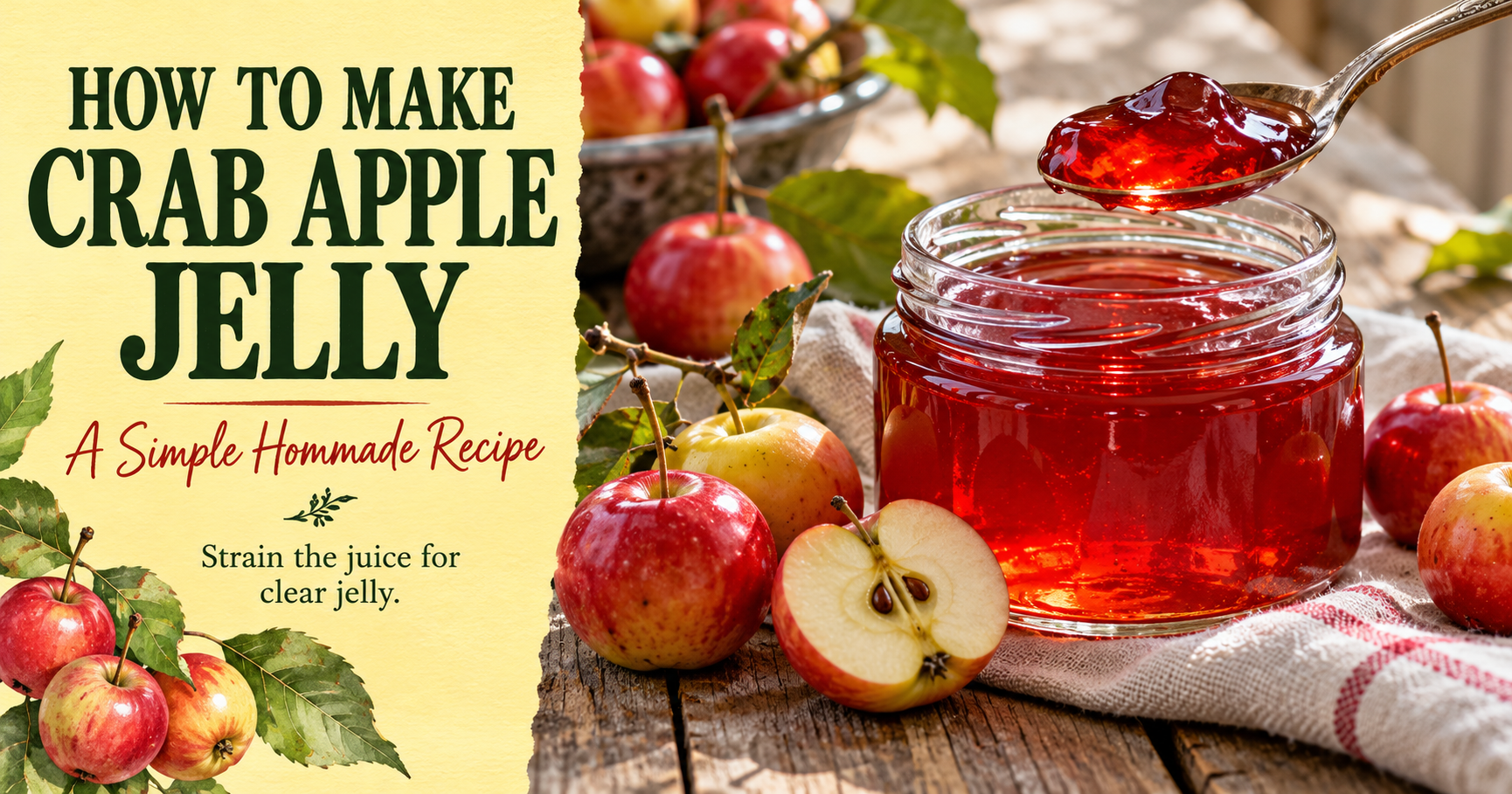
If you enjoy making jelly from homegrown fruit, our homemade crab apple jelly recipe explains how juice extraction and natural pectin fit into the process.
Can You Add Pectin After the Jelly Has Already Been Made?
Sometimes.
But you shouldn’t simply sprinkle powdered pectin into a jar and stir.
Remaking soft jelly requires a specific process, and the instructions differ depending on whether the original batch used powdered pectin, liquid pectin, or no added pectin.
I’ll explain those differences in the repair section of this guide.
2. You Changed the Amount of Sugar
This is one of the easiest mistakes to make, especially when you’re trying to make a healthier or less-sweet jelly.
I understand why someone would want to reduce the sugar.
Some traditional jelly recipes use a surprisingly large amount.
But the problem is that sugar is part of the chemistry.
If you use a regular high-sugar pectin recipe and cut the sugar significantly, the mixture may never develop the proper gel.
The same thing can happen if you substitute a different sweetener without using a recipe designed for it.
Can Too Much Sugar Prevent Jelly From Setting?
Yes, excessive sugar can cause problems too.
Instead of producing a nice, spreadable gel, you may end up with jelly that’s overly firm, grainy, or filled with sugar crystals.
More sugar isn’t automatically better.
The goal is the correct proportion for the pectin and juice you’re using.
How I’d Avoid This Problem
I’d measure the sugar before starting.
I also wouldn’t adjust the quantity halfway through cooking just because the jelly looked thin.
Hot jelly naturally looks more liquid than cooled jelly.
Adding extra sugar because you’re worried about the appearance can create a completely different problem.

3. You Used the Wrong Type of Pectin
This one deserves more attention because the different pectin products sold in stores aren’t interchangeable.
You’ll commonly find regular powdered pectin, liquid pectin, and low-sugar or no-sugar-needed pectin.
They don’t necessarily use the same ingredient proportions or cooking instructions.
Powdered Pectin
Many traditional powdered-pectin recipes require combining the pectin with the fruit juice before adding the full amount of sugar.
The mixture is then brought to a boil according to the recipe’s directions.
Liquid Pectin
Liquid pectin is often added at a different stage of cooking.
Some recipes require adding it after the juice and sugar have reached a particular boiling point.
Low-Sugar Pectin
Low-sugar pectins may use different gelling chemistry, including calcium-dependent formulations.
That means a recipe written for traditional powdered pectin may not work correctly if you substitute a low-sugar product.
Can You Substitute Liquid Pectin for Powdered Pectin?
I wouldn’t.
Not unless you’re using a tested recipe specifically designed for that substitution.
If you have powdered pectin, follow a powdered-pectin recipe.
If you have liquid pectin, use instructions developed for liquid pectin.
It’s a simple rule that can prevent a lot of wasted fruit and sugar.
4. You Didn’t Boil the Jelly Long Enough
Sometimes the recipe and ingredients are correct, but the jelly simply hasn’t reached its proper setting point.
This is particularly common when making traditional jelly without added pectin.
The juice needs to become concentrated enough for the pectin to form a gel.
If too much water remains, the mixture may stay runny.
What Is a Full Rolling Boil?
A full rolling boil is a vigorous boil that continues even while you’re stirring.
That’s different from a gentle simmer.
Some commercial pectin recipes require a full rolling boil for a specific period.
If the instructions call for one minute at a full rolling boil, starting the timer while the mixture is only simmering can affect the result.
Why I Wouldn’t Judge Jelly by Cooking Time Alone
Traditional no-added-pectin jelly is a little different.
The time needed can vary based on the amount of juice, the pot’s surface area, and the stove’s heat output.
Instead of relying only on the clock, I’d use the setting tests recommended by the recipe.
For traditional jelly, one familiar method is the sheet test.
Dip a cool metal spoon into the boiling mixture, lift it, and watch how the liquid falls.
When the mixture is thin, it drips in separate drops.
As it approaches the setting point, the drops begin joining together and falling in a sheet.
A thermometer can also help. Traditional jelly commonly reaches its setting point around 8°F above the boiling point of water at your elevation.
At sea level, that’s approximately 220°F, but the target is lower at higher elevations.
5. You Cooked the Jelly Too Long
This might sound strange after discussing undercooking.
But yes, overcooking can also cause jelly problems.
More boiling doesn’t always mean a firmer set.
Excessive cooking can damage pectin and change the final consistency.
It can also darken the jelly, weaken its fresh fruit flavor, and increase the chance of scorching.
Why This Happens
Pectin is sensitive to prolonged heating under certain conditions.
Once the mixture reaches its proper setting point, continuing to boil it unnecessarily can affect the gel.
That’s why I wouldn’t leave jelly cooking while I clean the kitchen or prepare jars.
I want everything ready before the mixture reaches its final stage.
Can Overcooked Jelly Be Saved?
It depends on what happened.
If the jelly became overly firm, the solution isn’t necessarily the same as repairing a loose batch.
If the mixture scorched, there’s no reliable way to remove that burnt flavor.
And if the pectin was damaged, simply cooking it longer may make the problem worse.
For a failed batch, I’d use tested remake instructions rather than experimenting with random additions.
6. You Made Too Large of a Batch
This is a mistake I think is especially easy to make when you’ve harvested a lot of fruit.
Imagine having several buckets of apples or blackberries ready to preserve.
It seems logical to double or triple the recipe so you can finish everything faster.
Unfortunately, jelly doesn’t always cooperate.
A larger batch takes longer to heat evenly and may require considerably more time to reach the proper concentration.
That extended cooking can affect pectin and lead to an inconsistent set.
Penn State Extension specifically recommends making manageable batches instead of automatically doubling jelly recipes.
Penn State Extension
Why a Bigger Pot Doesn’t Always Solve the Problem
Using a larger pot gives you more room, but it doesn’t necessarily fix the cooking chemistry.
The mixture still needs to reach the correct concentration.
And the longer it takes, the greater the chance of overcooking part of the mixture or missing the proper setting point.
If a tested recipe makes four or five jars, I’d stick with that amount and prepare another batch afterward.
It might seem slower, but I’d rather finish with eight jars of properly set jelly than twelve jars of syrup.
7. Your Fruit Juice Was Too Diluted
This problem often begins before you even start making the jelly.
When extracting juice from apples, crab apples, or berries, you usually add some water to help soften the fruit.
But adding too much water dilutes everything.
The flavor becomes weaker.
The natural pectin becomes less concentrated.
And the mixture may need more cooking to reach the setting point.
Why This Matters With Homemade Apple Jelly
Let’s say you’re cooking apples to extract their juice.
You add more water than the recipe calls for because you don’t want anything sticking to the pot.
After straining, you have plenty of liquid, which initially seems like a good thing.
But that extra juice isn’t necessarily an advantage.
It may contain substantially less natural pectin per cup.
That’s one reason I would follow the water measurements carefully.
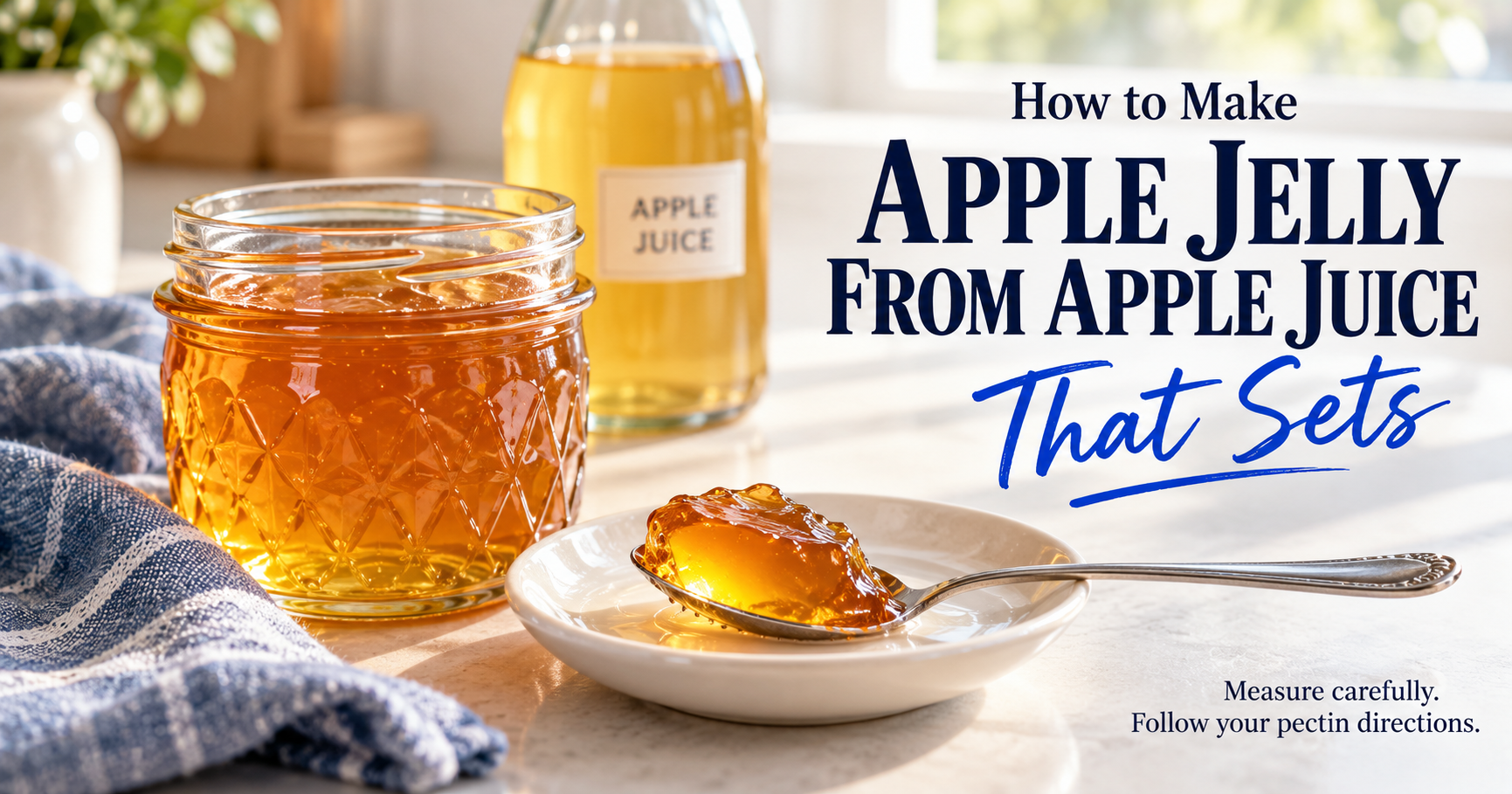
If you’re making jelly from commercially prepared juice instead, our apple jelly recipe using bottled apple juiceexplains why choosing the right juice and pectin matters.
8. The Fruit Juice Didn’t Have Enough Acid
Even if your jelly contains plenty of pectin and sugar, it may still struggle to set if the acidity is wrong.
This is especially important with traditional jelly made without added pectin.
The acid helps the pectin form the gel structure.
Some fruits naturally contain enough acid.
Others require added lemon juice.
Should You Just Add More Lemon Juice?
Not automatically.
Too little acid can prevent proper gelling, but too much can also cause problems, including liquid separating from the finished jelly.
I would follow a tested recipe rather than guessing at the amount.
For home canning, ingredient acidity can also be important to food safety, so untested adjustments aren’t something I’d recommend.
9. Your Pectin Was Old or Stored Improperly
This is another possibility people sometimes overlook.
Commercial pectin doesn’t necessarily perform the same way forever.
If you’ve had an old box sitting in the pantry, especially one that has been exposed to moisture or heat, it may not work as expected.
Penn State Extension recommends using fresh commercial pectin and checking package dates because older pectin can produce poor gels.
Penn State Extension
What I’d Check Before Making Another Batch
I’d look at the expiration date, make sure the package was properly sealed, and confirm that I was using the correct type of pectin.
I’d also check the directions again.
Some products come in different package sizes or formulations, and assuming they’re all identical can lead to incorrect measurements.
How to Fix Jelly That Didn’t Set
Now we get to the part that matters most.
You’ve already made the jelly.
It didn’t set.
You don’t want to waste it.
What can you actually do?
The good news is that the National Center for Home Food Preservation provides tested methods for remaking certain soft jellies.
The important part is choosing the correct method and following it precisely.
First, Make Sure the Jelly Really Failed
I wouldn’t immediately reopen jars that have only been cooling overnight.
Some jellies need several days to develop their final consistency.
Penn State Extension notes that certain batches can take three weeks or longer to set.
Penn State Extension
If the jelly was properly canned, the seals are intact, and there are no signs of spoilage, allow the recommended setting time before deciding to remake it.
If the original jelly wasn’t safely canned, keep it refrigerated while deciding what to do.
Never try to rescue spoiled jelly by boiling it again. If it has mold, fermentation, or other signs of spoilage, discard it.
How to Remake Soft Jelly With Powdered Pectin
The National Center for Home Food Preservation provides the following method for remaking soft jelly using powdered pectin.
For each quart (4 cups) of jelly, you’ll need:
- ¼ cup granulated sugar.
- ½ cup water.
- 2 tablespoons bottled lemon juice.
- 4 teaspoons powdered pectin.
Combine the sugar, water, lemon juice, and powdered pectin in a saucepan.
Bring the mixture to a boil while stirring.
Add the measured jelly and bring everything to a full rolling boil over high heat, stirring constantly.
Boil hard for 30 seconds.
Remove from the heat and skim off any foam.
For shelf-stable storage, fill sterile canning jars, leave ¼ inch of headspace, use new lids, and process according to the National Center’s tested remaking instructions and altitude requirements.
Work with no more than 4 to 6 cups of jelly at one time.
These measurements and directions come from the National Center for Home Food Preservation’s tested remake procedure.
National Center for Home Food Preservation
How to Remake Soft Jelly With Liquid Pectin
The liquid-pectin method is different.
For each quart (4 cups) of jelly, the tested procedure calls for:
- ¾ cup granulated sugar.
- 2 tablespoons bottled lemon juice.
- 2 tablespoons liquid pectin.
Bring the measured jelly to a boil over high heat while stirring.
Remove it from the heat and quickly add the sugar, bottled lemon juice, and liquid pectin.
Return the mixture to a full rolling boil, stirring constantly.
Boil hard for one minute.
Remove from the heat and skim the foam.
If canning, use sterile jars, ¼-inch headspace, new lids, and the tested boiling-water processing instructions.
Again, do not exceed the recommended small batch size.
Can You Remake Jelly Without Adding Pectin?
Yes, there is also a tested procedure for certain soft jellies that were originally made without added pectin.
For each quart of jelly, add 2 tablespoons of bottled lemon juice.
Heat to boiling and boil for approximately 3 to 4 minutes.
Use an appropriate jelly-setting test to determine when the mixture is ready.
Then follow the tested jar-filling and processing instructions.
I wouldn’t substitute this method for the powdered- or liquid-pectin procedure without checking that it applies to the original recipe.
What Processing Time Do Remade Jellies Need?
For the National Center’s tested remaking procedures, hot-packed jelly in half-pint or pint jars is processed in a boiling-water canner for:
- 5 minutes at elevations from 0 to 1,000 feet.
- 10 minutes at elevations from 1,001 to 6,000 feet.
- 15 minutes above 6,000 feet.
These times apply to the specific tested remake methods described above, not to arbitrary jelly recipes or untested ingredient changes.
National Center for Home Food Preservation
What If You Don’t Want to Remake the Jelly?
Here’s something I think gets overlooked.
Not every failed jelly batch needs to be remade.
If the mixture tastes good, was prepared safely, and has been stored correctly, you may still have something useful.
It just might not be jelly.
Use It as Pancake Syrup
A loose apple or berry jelly can make a wonderful topping for pancakes.
Warm a small portion and pour it over breakfast.
Depending on how sweet the original recipe was, you might not need any additional syrup.
Drizzle It Over Ice Cream
Fruit syrup can be delicious over vanilla ice cream.
Crab apple jelly syrup, for example, may have enough tartness to balance the sweetness of the ice cream.
Add It to Yogurt
A small spoonful of loose fruit jelly can add sweetness and flavor to plain yogurt.
This works particularly well with berry-based preserves.
Use It as a Glaze
Some fruit syrups work nicely in glazes for pork, chicken, or baked goods.
Just remember that changing a failed jelly into a sauce doesn’t make it shelf stable.
Keep it refrigerated and use it promptly unless you’re following a separately tested preservation recipe.
Why Does My Jelly Set and Then Turn Watery?
This is a different problem from jelly that never sets.
Sometimes a batch initially looks perfect.
Then, after sitting for a while, liquid begins collecting on top.
That separation is called syneresis, or weeping.
It can happen when the gel structure releases some of the water it was holding.
Excess acidity, changes in storage temperature, or an unstable gel can contribute to this problem.
Penn State Extension
A small amount of separation isn’t automatically a sign of spoilage.
However, if the jelly develops mold, unexpected gas, fermentation, or an unpleasant odor, it should be discarded.
Does Freezer Jelly Set Differently?
Yes.
Freezer jelly often uses a different formulation from traditional cooked jelly.
Some recipes use special freezer pectin, while others rely on a particular combination of fruit, sugar, and pectin.
The instructions may require stirring rather than boiling.
That’s why I wouldn’t assume that a freezer jelly can be repaired using the same method as a cooked, canned jelly.
Use the remake instructions designed for the original freezer jelly recipe.
How to Prevent Jelly From Failing Next Time
After looking at all the possible causes, I think prevention comes down to a handful of habits.
Measure Everything Before Starting
Jelly isn’t the best recipe for guessing.
I would measure the juice, sugar, pectin, and any required acid before turning on the stove.
Use a Tested Recipe
This is especially important if you’re planning to can the finished jelly.
A tested recipe helps ensure the ingredients and processing method work together.
Don’t Double the Batch
Make the quantity specified in the recipe.
If you want more jelly, prepare another batch.
Watch the Boil Carefully
Understand whether the recipe calls for a full rolling boil, a particular temperature, or a traditional setting test.
Those aren’t interchangeable instructions.
Don’t Rush the Cooling Process
After canning, let the jars cool undisturbed according to the recipe.
Moving jars unnecessarily while the gel is forming can affect the final texture.
Keep Notes About Each Batch
This is something I’d encourage anyone who regularly makes preserves to do.
Write down the fruit variety, recipe, pectin product, batch size, and whether the jelly set properly.
That information can be surprisingly helpful the next time you make the same recipe.
Frequently Asked Questions About Jelly That Won’t Set
Will jelly eventually set if I leave it alone?
Sometimes. Certain jellies take several days or even a few weeks to develop their final gel. But incorrect ingredient proportions or damaged pectin won’t necessarily correct themselves with time.
Can I put runny jelly in the refrigerator to make it set?
Refrigeration may help some formulations firm up, but it won’t reliably repair a failed traditional jelly recipe. If the pectin, sugar, and acid balance is wrong, chilling alone usually isn’t the solution.
Can I add gelatin to jelly that didn’t set?
Gelatin can create a gel, but it isn’t a direct substitute for fruit pectin in a tested shelf-stable canning recipe. I wouldn’t add gelatin to a failed batch and then attempt to can it using the original processing instructions.
Can I reboil jelly without adding anything?
Certain no-added-pectin jellies can be remade using a tested procedure, but simply boiling any failed jelly again isn’t a reliable fix. Excessive cooking can make matters worse.
Why did one batch set while another didn’t?
Even when using the same fruit, differences in ripeness, juice concentration, ingredient measurements, batch size, and cooking can affect the result.
Can too much lemon juice ruin jelly?
Yes. Too much acid can destabilize the gel and cause liquid separation. Follow the tested recipe rather than adding extra lemon juice by guesswork.
Is runny jelly safe to eat?
A loose set by itself doesn’t mean the jelly is unsafe. Safety depends on the ingredients, preparation, processing, storage, and whether spoilage has occurred. Properly refrigerated jelly may still be usable, while improperly canned jelly shouldn’t be treated as shelf stable.
Is runny jelly the same problem as runny apple butter?
No. Traditional jelly relies on pectin forming a gel under the right conditions. Apple butter thickens primarily through cooking and moisture reduction. That’s why the troubleshooting methods differ.
What I’d Remember Before Making Another Batch
If I were standing in the kitchen looking at a batch of jelly that hadn’t set, I wouldn’t immediately assume I’d wasted everything.
I’d first give it enough time.
Then I’d check the original recipe and think through the ingredients, pectin type, cooking process, and batch size.
If it truly failed, I’d decide whether a tested remake method was worthwhile or whether the mixture would be better enjoyed as fruit syrup.
The biggest thing I want readers to understand is that making jelly isn’t just about boiling fruit juice and hoping it thickens.
There’s a reason the measurements matter.
There’s a reason different pectins have different instructions.
And there’s a reason traditional jelly recipes have been tested so carefully.
Once you understand those details, the process becomes much less mysterious.
You don’t have to guess why your jelly didn’t set. You can work through the likely causes, choose a safe solution, and approach your next batch with a much better understanding of what makes homemade jelly work.
About the Author
Daxon Weaver is the owner of Weaver Family Farms Produce, where he shares practical information about growing fruit, making homemade jams and jellies, preserving seasonal harvests, and enjoying food from his family’s Missouri farm.