
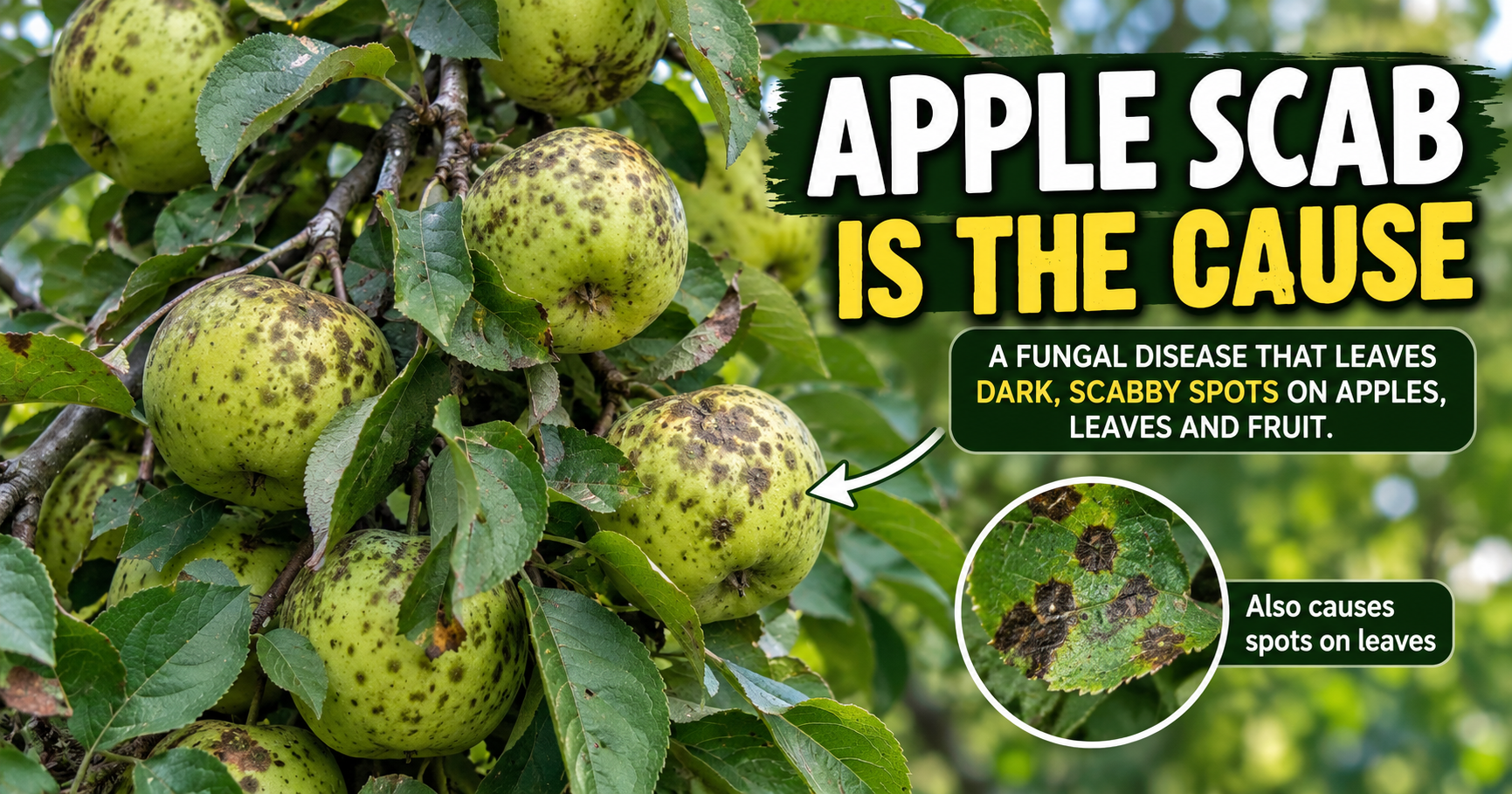
The first time I noticed black spots covering many of the apples growing on our trees, I wasn’t sure what I was looking at.
Some fruit had tiny black specks.
Others looked like someone had smeared dark gray soot across the skin.
A few even had rough, corky patches.
My first thought was simple.
“Are these apples ruined?”
After spending time learning about the different diseases and disorders that can affect apples, I realized something important.
Not every black spot has the same cause.
In fact, several completely different problems can leave apples looking very similar at first glance.
If your apples suddenly have black marks, here’s how I would begin narrowing it down.
Apple Scab
Apple scab is one of the most common fungal diseases affecting apple trees.
It usually starts as olive-green spots before turning darker as the season progresses.
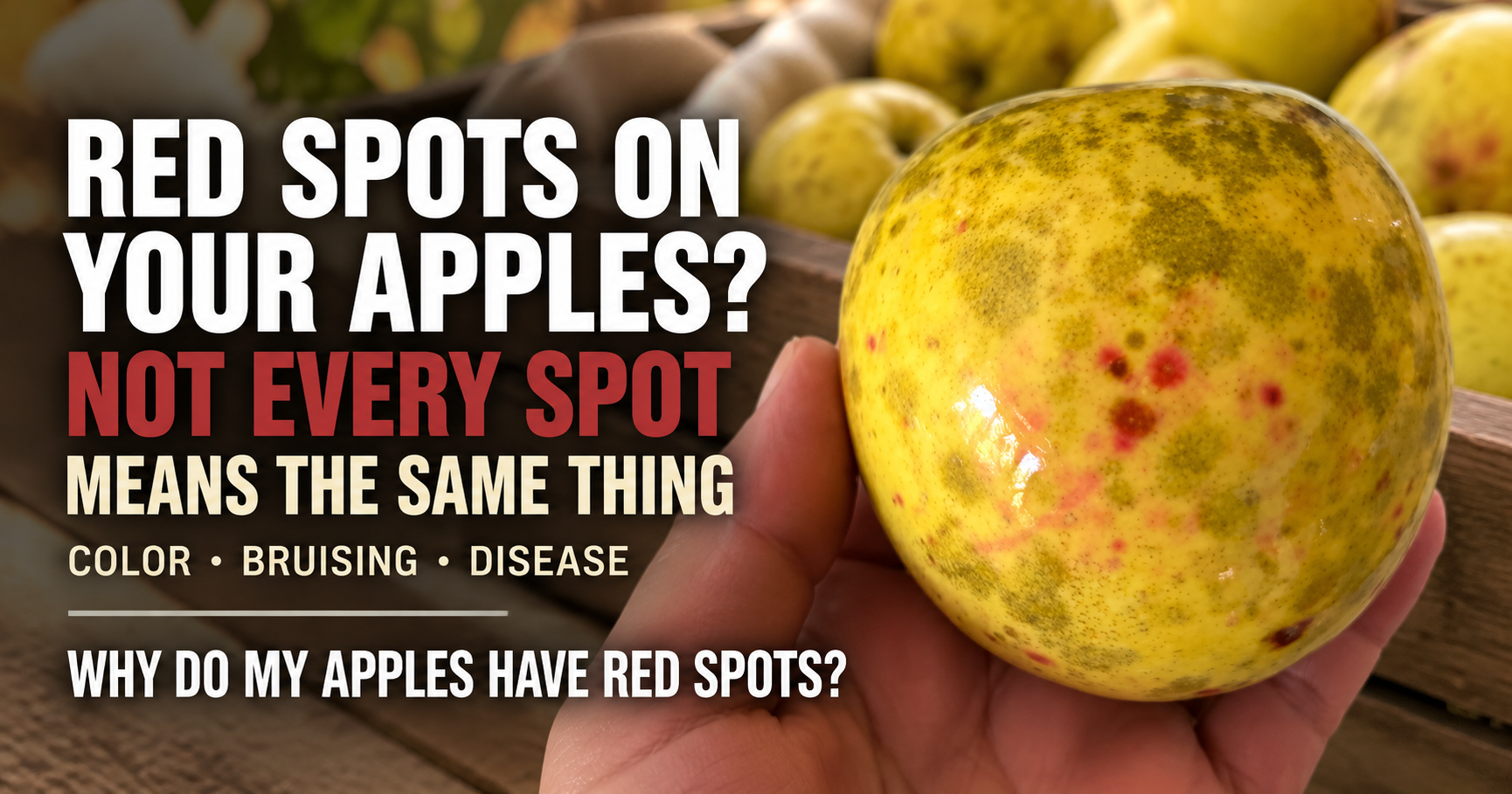
As the infection develops, the spots often become rough, corky, and slightly raised. Apple discoloration can vary, so red spots on apples may help you compare another common appearance.
In severe cases, apples may crack or become misshapen.
Unlike some other diseases, apple scab frequently affects both the fruit and the leaves.
If your tree also has dark spots on many of the leaves, apple scab moves much higher on my list of possibilities.
Signs I Look For
- Rough corky spots.
- Cracked fruit.
- Leaf spots.
- Misshapen apples.
Sooty Blotch
Sooty blotch is very different.
Instead of rough lesions, it creates gray or black smudges that almost look like someone rubbed charcoal dust across the apple.
The fungus stays on the surface of the fruit and usually doesn’t damage the flesh underneath.
Many apples with sooty blotch are still perfectly edible after washing or peeling.
Signs I Look For
- Gray or black smudges.
- Smooth surface.
- Fruit shape remains normal.
- Marks sometimes rub off partially.

Flyspeck
Flyspeck commonly appears alongside sooty blotch.
Instead of large smudges, you’ll notice tiny clusters of shiny black dots.
From a distance, they almost resemble black pepper sprinkled across the apple.
Like sooty blotch, flyspeck usually affects appearance much more than eating quality.
Signs I Look For
- Tiny black dots.
- Groups of dots rather than one large spot.
- Smooth skin.
- Usually cosmetic.
Bitter Rot
Bitter rot is one disease I take much more seriously.
Instead of staying on the surface, it actually rots the fruit.
The spots usually become sunken, soft, and expand over time.
Eventually, the apple begins breaking down.
Unlike sooty blotch, this isn’t simply a cosmetic issue.
Signs I Look For
- Soft sunken spots.
- Rotting flesh.
- Expanding circles.
- Fruit becoming mushy.

Black Rot
Black rot can also produce dark lesions on apples while causing dead areas on leaves and cankers on branches.
The fruit often develops firm, dark, sunken spots that gradually enlarge.
If I start seeing branch damage along with fruit problems, black rot becomes another disease worth considering.
Could It Be Insect Damage?
Sometimes the problem isn’t a fungus at all.
Stink bugs, plum curculio, apple maggots, and other insects can leave scars or dark marks that people mistake for disease.
That’s why I always take a close look before assuming it’s a fungal problem.
How I Narrow It Down
When I see black spots on apples, these are the first questions I ask myself.
- Are the spots smooth or rough?
- Do they rub off?
- Are the leaves affected too?
- Is the fruit rotting?
- Are insects present?
- Is the apple still firm?
Answering those questions usually eliminates several possibilities right away.
Are Apples With Black Spots Safe to Eat?
It depends entirely on what’s causing the problem.

If the spots are simply cosmetic, like sooty blotch or flyspeck, the apples are often still perfectly usable after washing or peeling. For practical guidance on whether spotted apples are safe to eat, inspect the fruit before deciding whether to keep it or discard it.
If the fruit has become soft, rotten, moldy, or badly damaged, I throw it away.
When in doubt, I cut the apple open.
The inside usually tells me much more than the outside.


My Honest Opinion
Black spots on apples can look alarming, but they don’t always mean you’ve lost your crop.
Some problems are mostly cosmetic.
Others require more attention.
That’s why I never try to diagnose an apple based on one symptom alone.
I look at the leaves.
I check the branches.
I examine the fruit up close.
And I remind myself that growing fruit means learning something new almost every season.
About the Author
Daxon Weaver is the owner of Weaver Family Farms Produce, where he shares firsthand experiences growing apples, pawpaws, Honey Jar and Sugar Cane jujubes, peaches, pears, berries, and other fruits on his family’s Zone 6a Missouri farm.