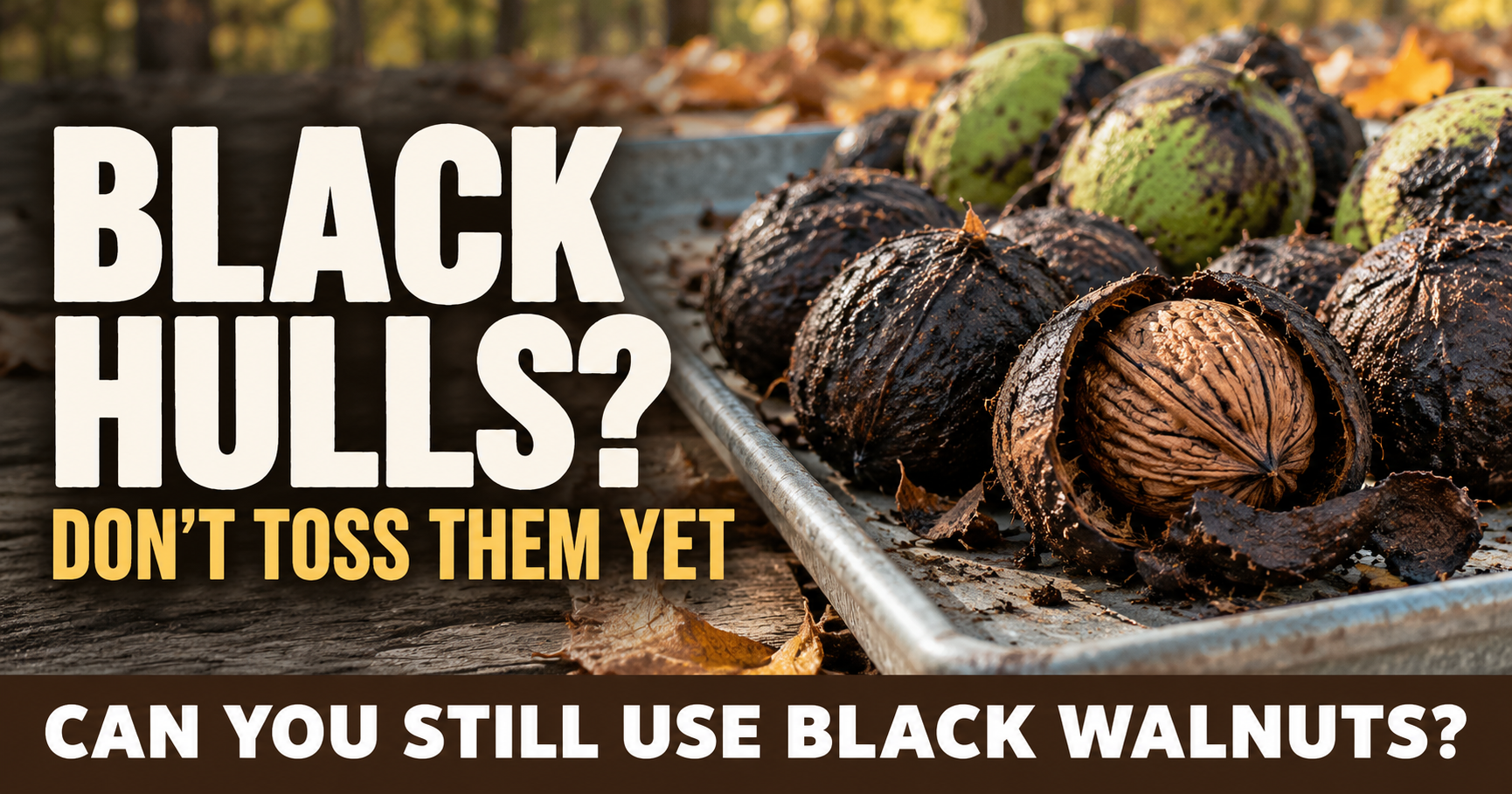
The first time I paid attention to black walnut season, I assumed the hull told me everything I needed to know.
Bright green?
Probably good.
Completely black?
Probably ruined.
It seemed like a pretty logical way to think about it.
Then I started learning more about black walnuts growing around our farm and realized the answer wasn’t nearly that simple.
Some walnuts with black hulls still contained perfectly good nuts.
Others looked fine on the outside but weren’t worth keeping.
Over time, I stopped judging black walnuts by color alone.
Instead, I started paying attention to several different clues before deciding whether they were worth processing.
If you’ve just started harvesting black walnuts, don’t assume every dark hull belongs in the trash.
Yes, You Can Often Still Use Them
One thing that surprised me is that a black hull doesn’t automatically mean the nut inside has gone bad.
As black walnuts mature, the outer hull naturally changes from bright green to darker shades before eventually becoming black and soft.
That process is completely normal.
In many cases, the shell inside is still perfectly healthy.
The challenge is figuring out when the hull has simply matured and when it’s started breaking down too far.
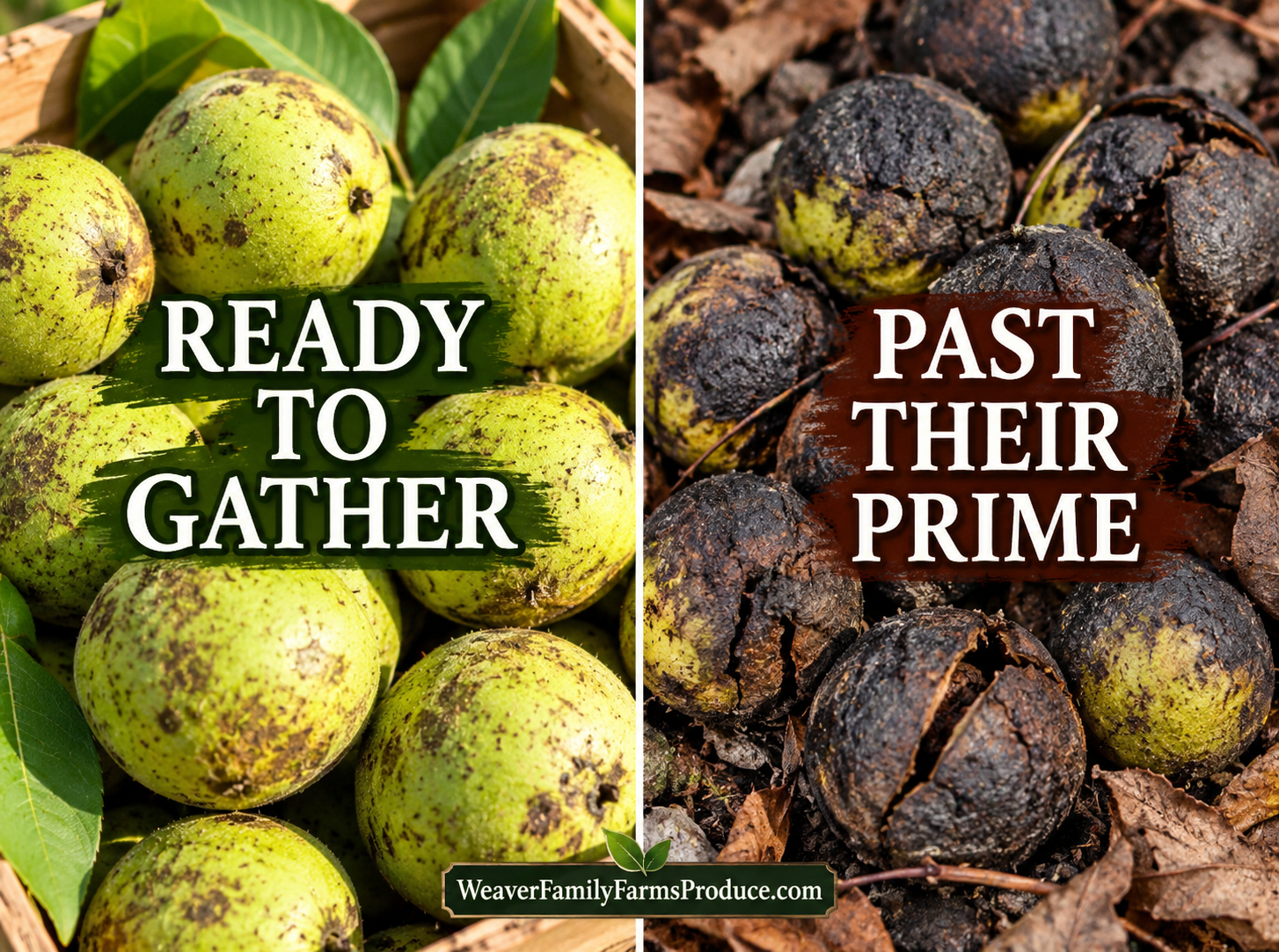
Black Doesn’t Always Mean Rotten
This is probably the biggest misconception I had.
Black walnut hulls naturally darken with age.
Sometimes that happens while the walnuts are still hanging in the tree.
Other times it happens after they’ve been lying on the ground for a while.
Color by itself doesn’t tell the whole story.
Instead, I ask a few questions.
Is the hull merely black?
Or is it also mushy, foul-smelling, or filled with insects?
Those answers matter much more than the color alone.

I Pay More Attention to the Hull’s Condition
When I’m sorting walnuts, I don’t focus only on whether the hull is green or black.
Instead, I look at how it feels.
If the hull is still fairly firm, I usually continue processing it.
If it has turned into a soft, slimy mess that’s falling apart in my hands, I become much more selective.
Sometimes the nut inside is still perfectly usable.
Sometimes it isn’t.
The only way to know for sure is to remove the hull.
Remove the Hull as Soon as You Can
One thing I’ve learned is that waiting rarely improves the situation.
Once walnuts are harvested, I like removing the hulls as soon as reasonably possible.
Prompt hulling helps preserve kernel quality and reduces problems caused by insects and prolonged exposure to the decaying hull. That’s one reason University of Missouri guidance recommends hulling harvested walnuts promptly rather than allowing them to sit in their husks.
Even if the hull has already begun turning black, I don’t simply leave it there.
I process it and let the nut itself determine whether it’s worth keeping.

Insects Don’t Always Ruin the Nut
Another thing that surprised me was discovering insects inside some hulls.
It looks alarming the first time you see it.
Fortunately, insects feeding in the outer hull don’t automatically mean the nut inside has been damaged.
Extension experts note that even hulls affected by husk flies or similar insects may still contain usable nuts if the shell remains intact, although flavor can decline if hulling is delayed too long.
That’s why I never throw a walnut away simply because the hull looks ugly.
I remove the hull first.
Then I inspect the shell.
The Shell Tells Me More Than the Hull
Once the hull comes off, everything becomes much easier.
I’m looking for a shell that’s:
- Hard.
- Solid.
- Free from obvious holes.
- Not cracked.
- Not moldy.
A healthy shell gives me much more confidence than a pretty green hull ever could.
If the shell looks good, I’ll wash it and continue with the curing process.
The Float Test Saves Time
After washing the hulled walnuts, I usually perform one simple test.
I place them in a bucket of water.
Walnuts that float are often poorly filled or empty.
Those usually aren’t worth spending more time on.
The sinkers are the ones I focus on drying.
This isn’t a perfect test, but it’s a quick way to sort through a large harvest. Iowa State and Missouri Extension both recommend discarding most floaters because they’re commonly unfilled or poor-quality nuts.
When I Throw Them Away
There are definitely times when I don’t bother trying to save a walnut.
If I remove the hull and find:
- A badly damaged shell.
- Obvious mold.
- Large holes from insects.
- A shell that’s already cracked open.
- A foul smell coming from the nut.
I’m finished with it.
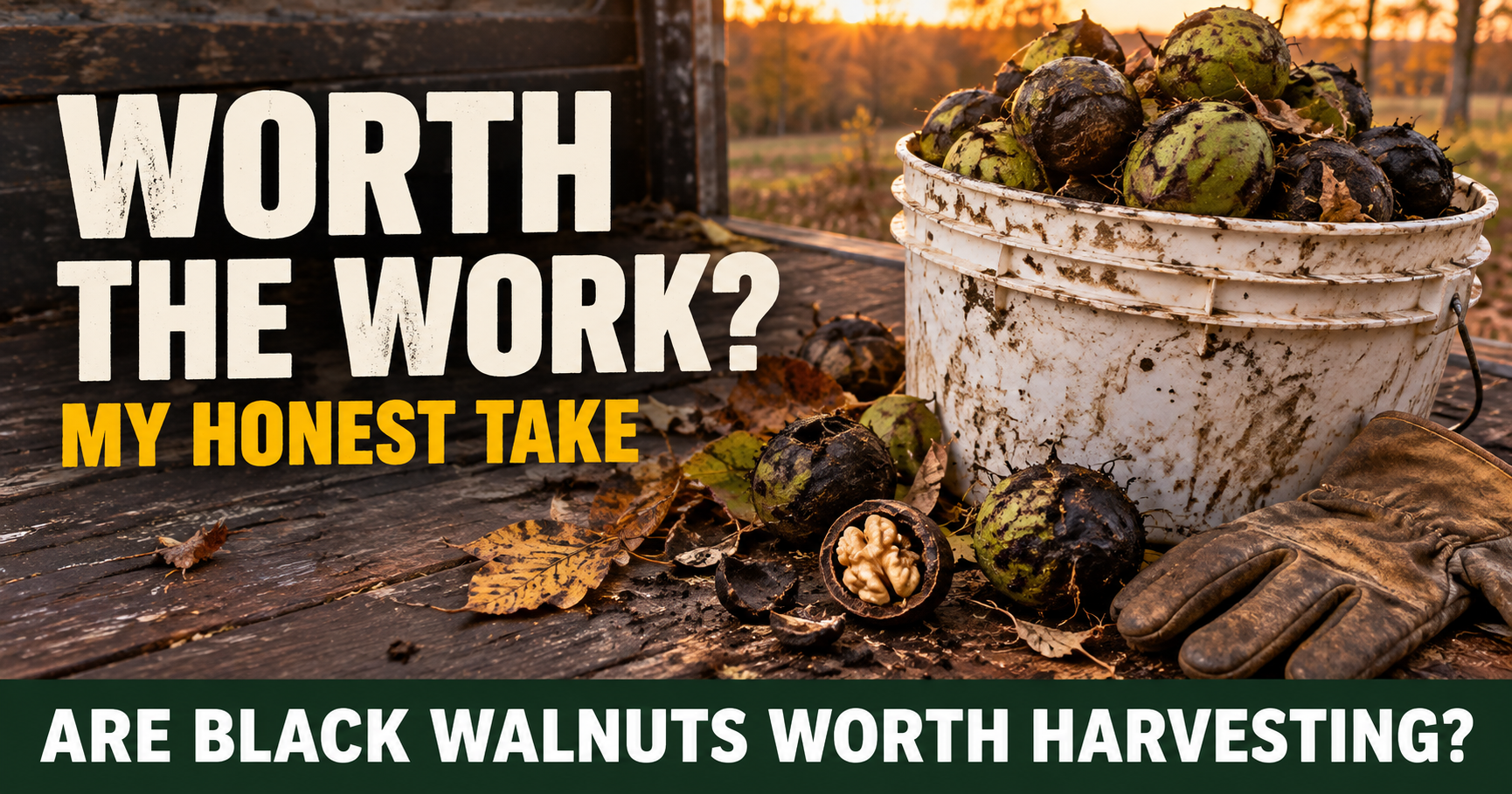
Harvesting black walnuts takes enough work that I’d rather spend my time on good nuts than questionable ones. That question of effort and reward is explored further in work of harvesting black walnuts.
My Honest Opinion
If someone handed me two black walnuts today, one with a bright green hull and one with a black hull, I wouldn’t automatically choose the green one.
I’d remove both hulls.
I’d inspect both shells.
Then I’d decide.
Growing and harvesting black walnuts has taught me not to judge them by the outside.
Sometimes the ugliest walnut in the bucket turns out to have a beautiful nut inside.
And sometimes the prettiest one disappoints you.
That’s just part of harvesting food from the land.
About the Author
Daxon Weaver is the owner of Weaver Family Farms Produce, where he shares firsthand experiences harvesting black walnuts, growing fruit, preserving seasonal harvests, and helping others enjoy homegrown food on his family’s Zone 6a Missouri farm.